The role of indirect photochemical degradation in the environmental fate of pesticides: a review?
Environmental Science: Processes & Impacts Pub Date: 2014-01-02 DOI: 10.1039/C3EM00549F
Abstract
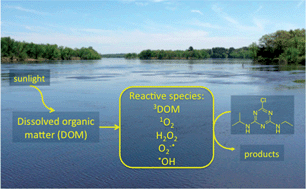
Photochemical degradation contributes to the environmental fate of many pesticides in surface waters. A better understanding of the role of direct and indirect photochemical degradation of pesticides is necessary in order to predict their environmental fate and persistence. This review includes all major pesticide classes and focuses on the importance of dissolved organic matter (DOM) as a sensitizer in indirect photodegradation within aquatic systems. Photochemical studies conducted under environmentally relevant conditions (i.e., aqueous solutions with irradiation wavelengths >290 nm) are included. Comparisons are made between observed photodegradation rates in pure or buffered water and in water containing DOM to assess the extent of pesticide susceptibility to DOM-sensitized indirect photolysis. When data is available, the role of specific reactive species in indirect photodegradation is described. While it is possible to assess the relative importance of direct and indirect photodegradation on a pesticide-by-pesticide basis in many cases, it is often difficult to make generalizations based on compound class. Knowledge gaps and inconstancies in the current body of literature are discussed and areas that require additional research are described.
Recommended Literature
- [1] Emerging investigator series: bacteriophages as nano engineering tools for quality monitoring and pathogen detection in water and wastewater Fereshteh BayatEnviron. Sci.: Nano, 2021,8, 367-389 10.1039/D0EN00962H
- [2] Establishing new scaling relations on two-dimensional MXenes for CO2 electroreduction? Albertus D. Handoko,Khoong Hong Khoo,Teck Leong Tan,Hongmei Jin,Zhi Wei SehJ. Mater. Chem. A, 2018,6, 21885-21890 10.1039/C8TA06567E
- [3] Fate of Sb(v) and Sb(iii) species along a gradient of pH and oxygen concentration in the Carnoulès mine waters (Southern France) Eléonore Resongles,Corinne Casiot,Fran?oise Elbaz-Poulichet,Rémi Freydier,Odile Bruneel,Christine Piot,Sophie Delpoux,Aurélie Volant,Angélique DesoeuvreEnviron. Sci.: Processes Impacts, 2013,15, 1536-1544 10.1039/C3EM00215B
- [4] Establishing empirical design rules of nucleic acid templates for the synthesis of silver nanoclusters with tunable photoluminescence and functionalities towards targeted bioimaging applications? Jason Y. C. Lim,Yong Yu,Guorui Jin,Kai Li,Yi Lu,Jianping XieNanoscale Adv., 2020,2, 3921-3932 10.1039/D0NA00381F
- [5] Emulsifier-free, organotellurium-mediated living radical emulsion polymerization (emulsion TERP) of styrene: poly(dimethylaminoethyl methacrylate) macro-TERP agent? Yukiya KitayamaPolym. Chem., 2014,5, 2784-2792 10.1039/C3PY01539D
- [6] Dissociative dynamics of O2 on Ag(110)? Ivor Lon?ari?Phys. Chem. Chem. Phys., 2015,17, 9436-9445 10.1039/C4CP05900J
- [7] Excellent electrochemical performance of LiFe0.4Mn0.6PO4 microspheres produced using a double carbon coating process? Yong Ping Huang,Tao Tao,Zheng Chen,Wei Han,Ying Wu,Chunjiang Kuang,Shaoxiong Zhou,Ying ChenJ. Mater. Chem. A, 2014,2, 18831-18837 10.1039/C4TA03994G
- [8] Excellent peroxidase mimicking property of CuO/Pt nanocomposites and their application as an ascorbic acid sensor? Xinhuan Wang,Shuangfei Cai,Cui QiAnalyst, 2017,142, 2500-2506 10.1039/C7AN00589J
- [9] Excellent energy storage performance in NaNbO3-based relaxor antiferroeic ceramics under a low electric field XuxinCheng,XiaomingChen,PengyuanFan 10.1007/s10832-022-00283-w
- [10] Esterase-responsive polymeric prodrug-based tumor targeting nanoparticles for improved anti-tumor performance against colon cancer? Gang Pan,Yi-jie Bao,Jie Xu,Tao Liu,Cheng Liu,Yan-yan Qiu,Xiao-jing Shi,Hui Yu,Ting-ting Jia,Xia Yuan,Ze-ting Yuan,Yi-jun CaoRSC Adv., 2016,6, 42109-42119 10.1039/C6RA05236C

Journal Name:Environmental Science: Processes & Impacts
research_products
-

CAS no.: 89640-58-4


![N-(3-cyanothiolan-3-yl)-2-[(2,2,2-trifluoroethyl)sulfanyl]pyridine-4-carboxamide](https://ossimg.kuujia.com/scimg/1444500/1444113-98-7x500.png)

![1,2,3,4,5,6-Hexahydro-[2,3]bipyridinyl-6-ol](https://ossimg.kuujia.com/scimg/1271000/1270529-38-8x500.png)

![2,2-Difluoro-3-[methyl(2-methylbutyl)amino]propanoic acid](https://ossimg.kuujia.com/scimg/2138500/2138166-62-6x500.png)

![2-(1H-indol-3-yl)-N-{[6-(thiophen-2-yl)-[1,2,4]triazolo[4,3-b]pyridazin-3-yl]methyl}acetamide](https://ossimg.kuujia.com/scimg/2034500/2034271-14-0x500.png)