Acid degradable poly(vinylcaprolactam)-based nanogels with ketal linkages for drug delivery?
Journal of Materials Chemistry B Pub Date: 2015-06-16 DOI: 10.1039/C5TB00703H
Abstract
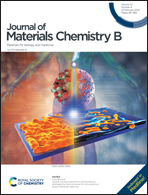
To improve the biocompatibility and biodegradability of nanocarriers, well-defined poly(vinylcaprolactam)-based acid degradable nanogels were fabricated for drug delivery via precipitation polymerization in water, where synthetic ketal-based 2,2-dimethacroyloxy-1-ethoxypropane (DMAEP) acted as a cross-linker, and N-(2-hydroxypropyl)methacrylamide (HPMA) served as a co-monomer. Expectedly, we observed that the temperature and pH of the environment play important roles in the performance of the nanogels. The nanogels were reduced in size upon increasing the temperature and showed higher volume phase transition temperature (VPTT) with higher concentration of HPMA. With the incorporation of ketal linkages, the nanogels showed accelerated degradation profiles by lowering the pH and increasing temperature of the incubation medium. When used as nanocarriers of anticancer drug doxorubicin (DOX), compared to non-degradable nanogels with similar components, the acid-degradable nanogels displayed more effective drug controlled release behaviour, low drug leakage of DOX at neutral pH while rapid and sufficient release from the nanogels under acidic conditions. The results of the cytotoxicity and hemolysis assays further highlighted that the acid-degradable nanogel produced no hemolysin but showed excellent viability to normal cells, and the DOX-loaded nanogel exhibited higher proliferation inhibition against tumor cells.

Recommended Literature
- [1] Evolved polymerases facilitate selection of fully 2′-OMe-modified aptamers? Zhixia Liu,Tingjian Chen,Floyd E. RomesbergChem. Sci., 2017,8, 8179-8182 10.1039/C7SC03747C
- [2] Exciplex emission from the mixed dimer of naphthalene and 2-cyanonaphthalene in a supersonic jet Aloke Das,K. K. Mahato,Chayan K. Nandi,Tapas Chakraborty,Shridhar R. Gadre,Nikhil A. GokhalePhys. Chem. Chem. Phys., 2002,4, 2162-2168 10.1039/B200124C
- [3] Estimates of hydride ion stability in condensed systems: energy of formation and solvation in aqueous and polar-organic solvents Craig A. Kelly,David R. RosseinskyPhys. Chem. Chem. Phys., 2001,3, 2086-2090 10.1039/B010092G
- [4] Fe(ii)-Assisted one-pot synthesis of ultra-small core–shell Au–Pt nanoparticles as superior catalysts towards the HER and ORR? Yi Cao,Yujiao Xiahou,Lixiang Xing,Xiang Zhang,Hong Li,ChenShou Wu,Haibing XiaNanoscale, 2020,12, 20456-20466 10.1039/D0NR04995F
- [5] Emerging investigator series: bacteriophages as nano engineering tools for quality monitoring and pathogen detection in water and wastewater Fereshteh BayatEnviron. Sci.: Nano, 2021,8, 367-389 10.1039/D0EN00962H
- [6] Evolution of dealloying induced strain in nanoporous gold crystals? Ross Harder,David C. Dunand,Ian McNultyNanoscale, 2017,9, 5686-5693 10.1039/C6NR09635B
- [7] Excitation energies from ground-state density-functionals by means of generator coordinates A. B. F. da Silva,K. CapellePhys. Chem. Chem. Phys., 2009,11, 4564-4569 10.1039/B902529D
- [8] Excellent humidity sensor based on ultrathin HKUST-1 nanosheets? Qiaoe Wang,Meiling Lian,Xiaowen Zhu,Xu ChenRSC Adv., 2021,11, 192-197 10.1039/D0RA08354B
- [9] Dissociative electron attachment to HGaF4 Lewis–Br?nsted superacid Marcin Czapla,Jack SimonsPhys. Chem. Chem. Phys., 2018,20, 21739-21745 10.1039/C8CP04007A
- [10] Fe(iii)-mediated isomerization of α,α-diarylallylic alcohols to ketones via radical 1,2-aryl migration? Ziyang Deng,Changwei Chen,Sunliang CuiRSC Adv., 2016,6, 93753-93755 10.1039/C6RA20007A
Journal Name:Journal of Materials Chemistry B
research_products
-

CAS no.: 89640-58-4


![N-(3-cyanothiolan-3-yl)-2-[(2,2,2-trifluoroethyl)sulfanyl]pyridine-4-carboxamide](https://ossimg.kuujia.com/scimg/1444500/1444113-98-7x500.png)

![1,2,3,4,5,6-Hexahydro-[2,3]bipyridinyl-6-ol](https://ossimg.kuujia.com/scimg/1271000/1270529-38-8x500.png)

![2,2-Difluoro-3-[methyl(2-methylbutyl)amino]propanoic acid](https://ossimg.kuujia.com/scimg/2138500/2138166-62-6x500.png)

![2-(1H-indol-3-yl)-N-{[6-(thiophen-2-yl)-[1,2,4]triazolo[4,3-b]pyridazin-3-yl]methyl}acetamide](https://ossimg.kuujia.com/scimg/2034500/2034271-14-0x500.png)