The reactions of dimethyl carbonate and its derivatives
Green Chemistry Pub Date: 2017-10-30 DOI: 10.1039/C7GC01764B
Abstract
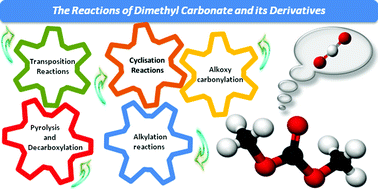
The worldwide urge to embrace a sustainable and bio-compatible chemistry has led industry and academia to develop of chlorine-free methodologies focused on the use of CO2 and CO2-based compounds as feedstocks, promoters and reaction media. In this scenario, dialkyl carbonates (DACs) and in particular dimethyl carbonate (DMC) occupy a privileged position due to their low toxicity, high biodegradability and peculiar reactivity. Nowadays, the large-scale production of DACs is carried out through clean processes (i.e., phosgene-free processes), which include the direct insertion of CO2 into epoxides, allowing – in principle – recycling of the carbon dioxide emitted during carbonate degradation. This groundbreaking achievement has definitely drawn attention toward the conception of procedures to activate the rather stable DACs with the aim of employing these compounds as green alternatives to their reactive chlorinated analogues. DACs are ambident electrophiles, which under appropriate conditions can undergo BAc2- or BAl2-nucleophilic substitution to give, respectively, alkoxycarbonylation and alkylation reactions. The many efforts devoted to improving the industrial suitability of organic carbonates have unveiled an intriguing and innovative chemistry as demonstrated by the numerous publications and patents published on these compounds over the last thirty years. This review reports on DACs as alkoxycarbonylating agents and their applications in industry and fine synthesis, as well as alkylating agents including allylic alkylation using palladium catalysts and the Pd/Ti bimetallic system and anchimerically driven alkylations via mustard carbonates. Moreover, the reactivity of organic carbonates toward several substrates and under different reaction conditions is described along with some distinctive DAC-mediated cyclization and transposition reactions. The synthesis of olefins and ethers under both liquid and gas phase conditions via thermal decarboxylation of organic carbonates is also reported.
Recommended Literature
- [1] An Assessment of the Laminar Hypersonic Double-Cone Experiments in the LENS-XX Tunnel JaideepRay,PatrickBlonigan,EricT.Phipps,KathrynMaupin 10.2514/1.j062802
- [2] An artificial CO-releasing metalloprotein built by histidine-selective metallation? Inês S. Albuquerque,Hélia F. Jeremias,Miguel Chaves-Ferreira,Dijana Matak-Vinkovic,Omar Boutureira,Carlos C. Rom?oChem. Commun., 2015,51, 3993-3996 10.1039/C4CC10204E
- [3] An analysis of the WTC fires using CIB correlations and simple modeling JGQuintiere 10.1177/0734904121989670
- [4] An integrated digital microfluidic chip for multiplexed proteomic sample preparation and analysis by MALDI-MS? Hyejin Moon,Aaron R. Wheeler,Robin L. Garrell,Chang-Jin “CJ” KimLab Chip, 2006,6, 1213-1219 10.1039/B601954D
- [5] An arsenic trioxide nanoparticle prodrug (ATONP) potentiates a therapeutic effect on an aggressive hepatocellular carcinoma model via enhancement of intratumoral arsenic accumulation and disturbance of the tumor microenvironment? Xin Fu,Qing-rong Liang,Rong-guang Luo,Yan-shu Li,Xiao-ping Xiao,Lu-lu Yu,Wen-zhe Shan,Guang-qin FanJ. Mater. Chem. B, 2019,7, 3088-3099 10.1039/C9TB00349E
- [6] An atmosphere and light tuned highly diastereoselective synthesis of cyclobuta/penta[b]indoles from aniline-tethered alkylidenecyclopropanes with alkynes? Bo Cao,Yin WeiChem. Commun., 2018,54, 2870-2873 10.1039/C8CC00180D
- [7] An investigation on the second-order nonlinear optical response of cationic bipyridine or phenanthroline iridium(iii) complexes bearing cyclometallated 2-phenylpyridines with a triphenylamine substituent? David B. Cordes,Alexandra M. Z. Slawin,Stefania Righetto,Denis Jacquemin,Eli Zysman-Colman,Véronique GuerchaisDalton Trans., 2018,47, 8292-8300 10.1039/C8DT00754C
- [8] Acetyl protected thiol methacrylic polymers as effective ligands to keep quantum dots in luminescent standby mode? Marta Liras,Isabel Quijada-Garrido,Marta Palacios-Cuesta,Sonia Mu?oz-Durieux,Olga GarcíaPolym. Chem., 2014,5, 433-442 10.1039/C3PY00987D
- [9] An insight into the role of side chains in the microstructure and carrier mobility of high-performance conjugated polymers? Jianyao Huang,Dong Gao,Zhihui Chen,Weifeng ZhangPolym. Chem., 2021,12, 2471-2480 10.1039/D1PY00105A
- [10] An investigation of surface properties, local elastic modulus and interaction with simulated pulmonary surfactant of surface modified inhalable voriconazole dry powders using atomic force microscopy Michael Kappl,Paul M. Young,Daniela Traini,Sanyog JainRSC Adv., 2016,6, 25789-25798 10.1039/C6RA01154C

Journal Name:Green Chemistry
research_products
-

CAS no.: 89640-58-4

![1,2,3,4,5,6-Hexahydro-[2,3]bipyridinyl-6-ol](https://ossimg.kuujia.com/scimg/1271000/1270529-38-8x500.png)


![N-(3-cyanothiolan-3-yl)-2-[(2,2,2-trifluoroethyl)sulfanyl]pyridine-4-carboxamide](https://ossimg.kuujia.com/scimg/1444500/1444113-98-7x500.png)

![2,2-Difluoro-3-[methyl(2-methylbutyl)amino]propanoic acid](https://ossimg.kuujia.com/scimg/2138500/2138166-62-6x500.png)

![2-(1H-indol-3-yl)-N-{[6-(thiophen-2-yl)-[1,2,4]triazolo[4,3-b]pyridazin-3-yl]methyl}acetamide](https://ossimg.kuujia.com/scimg/2034500/2034271-14-0x500.png)