The effect of dimerization on the activation and conformational dynamics of adenosine A1 receptor?
Physical Chemistry Chemical Physics Pub Date: 2019-10-03 DOI: 10.1039/C9CP04060A
Abstract
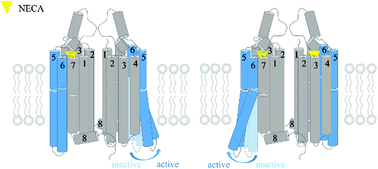
The adenosine A1 receptor (A1R) is one of four adenosine receptors in humans, which are involved in the function of the cardiovascular, respiratory and central nervous systems. Experimental results indicate that A1R can form a homodimer and that the protomer–protomer interaction in the A1R dimer is related to certain pharmacological characteristics of A1R activation. In this work, we performed docking, metadynamics simulation, conventional molecular dynamics simulations, Gaussian-accelerated molecular dynamics simulations, potential of mean force calculations, dynamic cross-correlation motions analysis and community network analysis to study the binding mode of 5′-N-ethylcarboxamidoadenosine (NECA) to A1R and the effect of dimerization on the activation of A1R. Our results show that NECA binds to A1R in a similar mode to adenosine in the A1R crystal structure and NECA in the A2AR crystal structure. The A1R homodimer can be activated by one or two agonists with NECA occupying its orthosteric pockets in one (which we call the NECA–A1R system) or both protomers (which we call the dNECA–A1R system). In the NECA–A1R system, activation is predicated in the protomer without NECA bound. In the dNECA–A1R system, only one protomer achieves the active state. These findings suggest an asymmetrical activation mechanism of the homodimer and a negative cooperativity between the two protomers. We envision that our results may further facilitate the drug development of A1R.
Recommended Literature
- [1] Estimating and correcting interference fringes in infrared spectra in infrared hyperspectral imaging Ghazal Azarfar,Ebrahim Aboualizadeh,Nicholas M. Walter,Simona Ratti,Camilla Olivieri,Alessandra Norici,Michael Nasse,Achim Kohler,Mario GiordanoAnalyst, 2018,143, 4674-4683 10.1039/C8AN00093J
- [2] Evidence of CO2 molecule acting as an electron acceptor on a nanoporous metal–organic-framework MIL-53 or Cr3+(OH)(O2C–C6H4–CO2)? Alexandre Vimont,Arnaud Travert,Philippe Bazin,Jean-Claude Lavalley,Marco Daturi,Christian Serre,Gérard Férey,Sandrine Bourrelly,Philip L. LlewellynChem. Commun., 2007, 3291-3293 10.1039/B703468G
- [3] Evolution of important glucosinolates in three common Brassica vegetables during their processing into vegetable powder and in vitro gastric digestion Nan Fu,Naphaporn Chiewchan,Xiao Dong ChenFood Funct., 2020,11, 211-220 10.1039/C9FO00811J
- [4] Excellent humidity sensor based on ultrathin HKUST-1 nanosheets? Qiaoe Wang,Meiling Lian,Xiaowen Zhu,Xu ChenRSC Adv., 2021,11, 192-197 10.1039/D0RA08354B
- [5] Evolution of dealloying induced strain in nanoporous gold crystals? Ross Harder,David C. Dunand,Ian McNultyNanoscale, 2017,9, 5686-5693 10.1039/C6NR09635B
- [6] Fe3O4 nanoclusters highly dispersed on a porous graphene support as an additive for improving the hydrogen storage properties of LiBH4? Guang Xu,Wei Zhang,Ying Zhang,Xiaoxia Zhao,Ping Wen,Di MaRSC Adv., 2018,8, 19353-19361 10.1039/C8RA02762E
- [7] Excitable dynamics in the bromate–sulfite–ferrocyanide reaction J. Zagora,M. Vosla?,L. Schreiberová,I. SchreiberPhys. Chem. Chem. Phys., 2002,4, 1284-1291 10.1039/B110048C
- [8] Fate of single walled carbon nanotubes in wetland ecosystems? Joseph H. Bisesi,Tara Sabo-AttwoodEnviron. Sci.: Nano, 2014,1, 574-583 10.1039/C4EN00063C
- [9] Emerging enantiomeric resolution materials with homochiral nano-fabrications Ji-Ping WeiNanoscale, 2015,7, 11815-11832 10.1039/C5NR03048J
- [10] Fatty acid positional distribution in colostrum and mature milk of women living in Inner Mongolia, North Jiangsu and Guangxi of China? Long Deng,Qian Zou,Biao Liu,Wenhui Ye,Chengfei Zhuo,Li Chen,Ze-Yuan Deng,Ya-Wei Fan,Jing LiFood Funct., 2018,9, 4234-4245 10.1039/C8FO00787J

Journal Name:Physical Chemistry Chemical Physics
research_products
-

CAS no.: 89640-58-4

![1,2,3,4,5,6-Hexahydro-[2,3]bipyridinyl-6-ol](https://ossimg.kuujia.com/scimg/1271000/1270529-38-8x500.png)


![N-(3-cyanothiolan-3-yl)-2-[(2,2,2-trifluoroethyl)sulfanyl]pyridine-4-carboxamide](https://ossimg.kuujia.com/scimg/1444500/1444113-98-7x500.png)

![2,2-Difluoro-3-[methyl(2-methylbutyl)amino]propanoic acid](https://ossimg.kuujia.com/scimg/2138500/2138166-62-6x500.png)

![2-(1H-indol-3-yl)-N-{[6-(thiophen-2-yl)-[1,2,4]triazolo[4,3-b]pyridazin-3-yl]methyl}acetamide](https://ossimg.kuujia.com/scimg/2034500/2034271-14-0x500.png)