Quantum-chemistry-aided identification, synthesis and experimental validation of model systems for conformationally controlled reaction studies: separation of the conformers of 2,3-dibromobuta-1,3-diene in the gas phase?
Physical Chemistry Chemical Physics Pub Date: 2020-06-02 DOI: 10.1039/D0CP01396J
Abstract
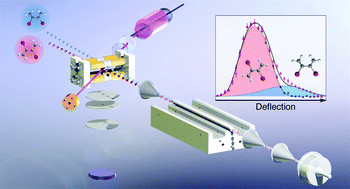
The Diels–Alder cycloaddition, in which a diene reacts with a dienophile to form a cyclic compound, counts among the most important tools in organic synthesis. Achieving a precise understanding of its mechanistic details on the quantum level requires new experimental and theoretical methods. Here, we present an experimental approach that separates different diene conformers in a molecular beam as a prerequisite for the investigation of their individual cycloaddition reaction kinetics and dynamics under single-collision conditions in the gas phase. A low- and high-level quantum-chemistry-based screening of more than one hundred dienes identified 2,3-dibromobutadiene (DBB) as an optimal candidate for efficient separation of its gauche and s-trans conformers by electrostatic deflection. A preparation method for DBB was developed which enabled the generation of dense molecular beams of this compound. The theoretical predictions of the molecular properties of DBB were validated by the successful separation of the conformers in the molecular beam. A marked difference in photofragment ion yields of the two conformers upon femtosecond-laser pulse ionization was observed, pointing at a pronounced conformer-specific fragmentation dynamics of ionized DBB. Our work sets the stage for a rigorous examination of mechanistic models of cycloaddition reactions under controlled conditions in the gas phase.
Recommended Literature
- [1] Excellent lithium ion storage property of porous MnCo2O4 nanorods? Peiyuan Zeng,Xiaoxiao Wang,Ming Ye,Qiuyang Ma,Jianwen Li,Wanwan Wang,Baoyou Geng,Zhen FangRSC Adv., 2016,6, 23074-23084 10.1039/C5RA26176G
- [2] Exchanged ligands on the surface of a giant cluster: [(MoO3)176(H2O)63(CH3OH)17Hn](32 – n)– Chem. Commun., 1998, 1501-1502 10.1039/A801804I
- [3] Fast-Track to Research Data Management in Experimental Material Science-Setting the Ground for Research Group Level Materials Digitalization. LarsBanko,AlfredLudwig 10.1021/acscombsci.0c00057
- [4] Evolution in surface coverage of CH3NH3PbI3?XClXvia heat assisted solvent vapour treatment and their effects on photovoltaic performance of devices Dhirendra K. Chaudhary,Pramendra Kumar,Lokendra KumarRSC Adv., 2016,6, 94731-94738 10.1039/C6RA18729C
- [5] Excimer emission and magnetoluminescence of radical-based zinc(ii) complexes doped in host crystals? Shojiro Kimura,Tetsuro KusamotoChem. Commun., 2020,56, 11195-11198 10.1039/D0CC04830E
- [6] Fast synthesis of copper nanoclusters through the use of hydrogen peroxide additive and their application for the fluorescence detection of Hg2+ in water samples? Liao Xiaoqing,Li Ruiyi,Li Zaijun,Sun Xiulan,Wang Zhouping,Liu JunkangNew J. Chem., 2015,39, 5240-5248 10.1039/C5NJ00831J
- [7] Distinct impact of glycation towards the aggregation and toxicity of murine and human amyloid-β? Eunju Nam,Jiyeon Han,Sunhee Choi,Mi Hee LimChem. Commun., 2021,57, 7637-7640 10.1039/D1CC02695J
- [8] Establishment and implications of a characterization method for magnetic nanoparticle using cell tracking velocimetry and magnetic susceptibility modified solutions Huading Zhang,Lee R. Moore,Maciej Zborowski,P. Stephen Williams,Shlomo Margel,Jeffrey J. ChalmersAnalyst, 2005,130, 514-527 10.1039/B412723D
- [9] Fe3O4 nanoparticle chains with N-doped carbon coating: magnetotactic bacteria assisted synthesis and high-rate lithium storage? Dan Yang,Yanping Zhou,Xianhong Rui,Jixin Zhu,Ziyang Lu,Eileen Fong,Qingyu YanRSC Adv., 2013,3, 14960-14962 10.1039/C3RA42116C
- [10] Excitonic and vibrational coherence in artificial photosynthetic systems studied by negative-time ultrafast laser spectroscopy Dongjia Han,Bing Xue,Juan Du,Tomohiro Miyatake,Hitoshi Tamiaki,Xin Xing,Wei Yuan,Yanyan LiPhys. Chem. Chem. Phys., 2016,18, 24252-24260 10.1039/C6CP03540J

Journal Name:Physical Chemistry Chemical Physics
research_products
-

CAS no.: 89640-58-4

![1,2,3,4,5,6-Hexahydro-[2,3]bipyridinyl-6-ol](https://ossimg.kuujia.com/scimg/1271000/1270529-38-8x500.png)


![N-(3-cyanothiolan-3-yl)-2-[(2,2,2-trifluoroethyl)sulfanyl]pyridine-4-carboxamide](https://ossimg.kuujia.com/scimg/1444500/1444113-98-7x500.png)

![2,2-Difluoro-3-[methyl(2-methylbutyl)amino]propanoic acid](https://ossimg.kuujia.com/scimg/2138500/2138166-62-6x500.png)

![2-(1H-indol-3-yl)-N-{[6-(thiophen-2-yl)-[1,2,4]triazolo[4,3-b]pyridazin-3-yl]methyl}acetamide](https://ossimg.kuujia.com/scimg/2034500/2034271-14-0x500.png)