Remote ion-pair interactions in Fe-porphyrin-based molecular catalysts for the hydrogen evolution reaction?
Catalysis Science & Technology Pub Date: 2019-02-08 DOI: 10.1039/C8CY02164C
Abstract
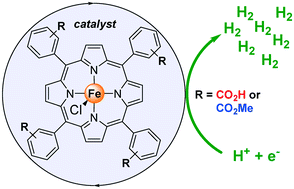
The environmentally benign production of clean energy is extremely important for the sustainable progress of our society. In this respect, dihydrogen (H2) has been considered in the last decades as an efficient energy carrier and much effort has been directed to the hydrogen evolution reaction (HER). Herein, we report on the efficiency of iron-based 5,10,15,20-tetraphenylporphyrins containing carboxylate groups in different positions (ortho, meta and para of the meso-substituted aryl groups of the porphyrin backbone) as molecular catalysts for the HER. The iron-based porphyrin containing the carboxylic acids in the ortho position was found completely inactive in the HER. Furthermore, besides stereoelectronic control, the subtle differences observed in the cyclic voltammograms (CV) as well as those associated with the electrocatalytic activity might involve a previously neglected ion-pair interaction between the carboxylate groups of the porphyrin scaffold and the chloride anions belonging to the proton source, which highlights the relevance of ion-pair contacts remote from the active center for this type of catalytic system.
Recommended Literature
- [1] Evolution in surface coverage of CH3NH3PbI3?XClXvia heat assisted solvent vapour treatment and their effects on photovoltaic performance of devices Dhirendra K. Chaudhary,Pramendra Kumar,Lokendra KumarRSC Adv., 2016,6, 94731-94738 10.1039/C6RA18729C
- [2] Evolution and characterization of a benzylguanine-binding RNA aptamer? J. Xu,T. J. Carrocci,A. A. HoskinsChem. Commun., 2016,52, 549-552 10.1039/C5CC07605F
- [3] Fe3O4 nanoclusters highly dispersed on a porous graphene support as an additive for improving the hydrogen storage properties of LiBH4? Guang Xu,Wei Zhang,Ying Zhang,Xiaoxia Zhao,Ping Wen,Di MaRSC Adv., 2018,8, 19353-19361 10.1039/C8RA02762E
- [4] Esterase-responsive polymeric prodrug-based tumor targeting nanoparticles for improved anti-tumor performance against colon cancer? Gang Pan,Yi-jie Bao,Jie Xu,Tao Liu,Cheng Liu,Yan-yan Qiu,Xiao-jing Shi,Hui Yu,Ting-ting Jia,Xia Yuan,Ze-ting Yuan,Yi-jun CaoRSC Adv., 2016,6, 42109-42119 10.1039/C6RA05236C
- [5] Evidence of pre-micellar aggregates in aqueous solution of amphiphilic PDMS–PEO block copolymer? Domenico Lombardo,Gianmarco Munaò,Pietro Calandra,Luigi Pasqua,Maria Teresa CaccamoPhys. Chem. Chem. Phys., 2019,21, 11983-11991 10.1039/C9CP02195G
- [6] Exceptionally high temperature spin crossover in amide-functionalised 2,6-bis(pyrazol-1-yl)pyridine iron(ii) complex revealed by variable temperature Raman spectroscopy and single crystal X-ray diffraction? Max Attwood,Hiroki Akutsu,Lee Martin,Toby J. Blundell,Pierre Le Maguere,Scott S. TurnerDalton Trans., 2021,50, 11843-11851 10.1039/D1DT01743H
- [7] Dissociation of large gaseous serine clusters produces abundant protonated serine octamer Jacob S. Jordan,Evan R. WilliamsAnalyst, 2021,146, 2617-2625 10.1039/D1AN00273B
- [8] Emerging 2D hybrid nanomaterials: towards enhanced sensitive and selective conductometric gas sensors at room temperature Hanie Hashtroudi,Ian D. R. MackinnonJ. Mater. Chem. C, 2020,8, 13108-13126 10.1039/D0TC01968B
- [9] Distinct impact of glycation towards the aggregation and toxicity of murine and human amyloid-β? Eunju Nam,Jiyeon Han,Sunhee Choi,Mi Hee LimChem. Commun., 2021,57, 7637-7640 10.1039/D1CC02695J
- [10] Excimer emission and magnetoluminescence of radical-based zinc(ii) complexes doped in host crystals? Shojiro Kimura,Tetsuro KusamotoChem. Commun., 2020,56, 11195-11198 10.1039/D0CC04830E

Journal Name:Catalysis Science & Technology
research_products
-

CAS no.: 89640-58-4

![1,2,3,4,5,6-Hexahydro-[2,3]bipyridinyl-6-ol](https://ossimg.kuujia.com/scimg/1271000/1270529-38-8x500.png)


![N-(3-cyanothiolan-3-yl)-2-[(2,2,2-trifluoroethyl)sulfanyl]pyridine-4-carboxamide](https://ossimg.kuujia.com/scimg/1444500/1444113-98-7x500.png)

![2,2-Difluoro-3-[methyl(2-methylbutyl)amino]propanoic acid](https://ossimg.kuujia.com/scimg/2138500/2138166-62-6x500.png)

![2-(1H-indol-3-yl)-N-{[6-(thiophen-2-yl)-[1,2,4]triazolo[4,3-b]pyridazin-3-yl]methyl}acetamide](https://ossimg.kuujia.com/scimg/2034500/2034271-14-0x500.png)