Self-assembly gel-based dynamic response system for specific recognition of N-acetylneuraminic acid?
Journal of Materials Chemistry B Pub Date: 2021-05-19 DOI: 10.1039/D1TB00627D
Abstract
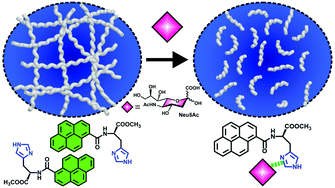
Sialic acids located at the terminal end of glycans are densely attached to cell surfaces and play crucial and distinctive roles in a variety of physiological and pathological processes, such as neural development, cell–cell interactions, autoimmunity and cancers. However, due to the subtle structural differences of sialic acid species and the complicated composition of glycans, the precise recognition of sialylated glycans is difficult. Here, a fluorescent dynamic response system based on a pyrene-conjugated histidine (PyHis) supramolecular gel is proposed. Driven by π–π stacking and intermolecular hydrogen bonds, PyHis exhibits a strong self-assembly ability and forms stable gels. It is found that introduction of N-acetylneuraminic acid (a typical sialic acid) can prevent this self-assembly process, whereas other monosaccharides or sialic acid analogs have no significant effect on it. Interestingly, a sialylated glycan also has a remarkable inhibitory effect on the gel formation, which highlights the high selectivity of the gel dynamic response system. Analysis of the mechanism reveals that the sialic acid or sialylated glycan can interact closely with two PyHis molecules stacked together in the assemblies via hydrogen bonding interactions, thereby preventing the ordered accumulation of the gelators. It is worth noting that the high-efficiency sialic acid recognition effect is not observed at the single molecule level but at the supramolecular level, indicating the unique superiority of the supramolecular self-assembly system in biomolecular recognition and response. This work shows the promising prospects of using supramolecular gels in assembly engineering, regenerative medicine, tumour cell sorting and cancer diagnosis.
Recommended Literature
- [1] Evolution of important glucosinolates in three common Brassica vegetables during their processing into vegetable powder and in vitro gastric digestion Nan Fu,Naphaporn Chiewchan,Xiao Dong ChenFood Funct., 2020,11, 211-220 10.1039/C9FO00811J
- [2] Excimer emission and magnetoluminescence of radical-based zinc(ii) complexes doped in host crystals? Shojiro Kimura,Tetsuro KusamotoChem. Commun., 2020,56, 11195-11198 10.1039/D0CC04830E
- [3] Evolutionary approaches in protein engineering towards biomaterial construction Brindha J.,Balamurali M. M.,Kaushik ChandaRSC Adv., 2019,9, 34720-34734 10.1039/C9RA06807D
- [4] Dissociation of large gaseous serine clusters produces abundant protonated serine octamer Jacob S. Jordan,Evan R. WilliamsAnalyst, 2021,146, 2617-2625 10.1039/D1AN00273B
- [5] Distinct correlation between (CN2)x units and pores: a low-cost method for predesigned wide range control of micropore size of porous carbon? Xiaotong Feng,Lei Bian,Jie Ma,Lei Zhou,Xiayan Wang,Guangsheng Guo,Qiaosheng PuChem. Commun., 2019,55, 3963-3966 10.1039/C9CC01213C
- [6] Evolution of hierarchical porous structures in supramolecular guest–host hydrogels? Christopher B. Rodell,Christopher B. Highley,Minna H. Chen,Neville N. Dusaj,Chao Wang,Lin Han,Jason A. BurdickSoft Matter, 2016,12, 7839-7847 10.1039/C6SM01395C
- [7] Emerging investigator series: heterogeneous reactions of sulfur dioxide on mineral dust nanoparticles: from single component to mixed components? Tao Wang,Yangyang Liu,Yue Deng,Hongbo Fu,Jianmin ChenEnviron. Sci.: Nano, 2018,5, 1821-1833 10.1039/C8EN00376A
- [8] Evidence of pre-micellar aggregates in aqueous solution of amphiphilic PDMS–PEO block copolymer? Domenico Lombardo,Gianmarco Munaò,Pietro Calandra,Luigi Pasqua,Maria Teresa CaccamoPhys. Chem. Chem. Phys., 2019,21, 11983-11991 10.1039/C9CP02195G
- [9] Evolution and characterization of a benzylguanine-binding RNA aptamer? J. Xu,T. J. Carrocci,A. A. HoskinsChem. Commun., 2016,52, 549-552 10.1039/C5CC07605F
- [10] Excited state dynamics of symmetric and asymmetric Cr3(dpa)4Cl2 measured using femtosecond transient absorption spectroscopy? Chao-Han Cheng,Wen-Zhen Wang,Shie-Ming Peng,I-Chia ChenPhys. Chem. Chem. Phys., 2017,19, 25471-25477 10.1039/C7CP03968A

Journal Name:Journal of Materials Chemistry B
research_products
-

CAS no.: 89640-58-4

![1,2,3,4,5,6-Hexahydro-[2,3]bipyridinyl-6-ol](https://ossimg.kuujia.com/scimg/1271000/1270529-38-8x500.png)


![N-(3-cyanothiolan-3-yl)-2-[(2,2,2-trifluoroethyl)sulfanyl]pyridine-4-carboxamide](https://ossimg.kuujia.com/scimg/1444500/1444113-98-7x500.png)

![2,2-Difluoro-3-[methyl(2-methylbutyl)amino]propanoic acid](https://ossimg.kuujia.com/scimg/2138500/2138166-62-6x500.png)

![2-(1H-indol-3-yl)-N-{[6-(thiophen-2-yl)-[1,2,4]triazolo[4,3-b]pyridazin-3-yl]methyl}acetamide](https://ossimg.kuujia.com/scimg/2034500/2034271-14-0x500.png)