Solvation properties of protic ionic liquids and molecular solvents?
Physical Chemistry Chemical Physics Pub Date: 2019-12-02 DOI: 10.1039/C9CP05711K
Abstract
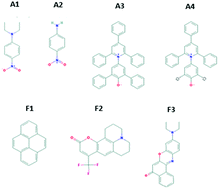
Ionic liquids (ILs) are highly tailorable solvents with many potential applications. Knowledge about their solvation properties is highly beneficial in the utilization of ILs for specific tasks, though for many ILs this is currently unknown. In this study, we have investigated the solvation properties of 12 protic ionic liquids (PILs) and 9 molecular solvents based on the Kamlet–Abboud–Taft′ (KAT) multi-parameter solvation scales. The KAT parameters, which are dipolarity/polarizability (π*), HBD acidity (α), HBA basicity (β), and the electronic transition energy (ET) were first obtained for the molecular solvents with an extensive set of 11 solvatochromic probe dye molecules. Based on these results the dyes which exhibited the highest sensitivities to polarity changes, and had the greatest chemical stability, were used to determine the KAT parameters of 12 PILs which contained alkyl-, dialkyl-, alkanol-, or dialkanolammonium cations paired with nitrate, formate or acetate anions. Solvation parameters were also obtained for the PILs using the three fluorescent probes pyrene, Coumarin 153 and Nile red for comparison. The PILs containing nitrate anions showed the greatest polarity, polarizability and HBD acidity followed by those containing formates and acetates. Almost all the PILs were found to have solvation properties comparable to water and single short chain alcohols like methanol and ethanol. The relative order of the IL polarities was similar for the solvatochromic and fluorescent probes. Through this study, in addition to the well-known distinct solvent properties of alkylammonium cation PILs, the high solvation capability of these PILs has been explicitly shown, which makes this class of ILs desirable for solvent-sensitive applications which require high polarity and H bonding ability.
Recommended Literature
- [1] Evolution of calcium phosphate precipitation in hanging drop vapor diffusion by in situRaman microspectroscopy Gloria Belén Ramírez-Rodríguez,José Manuel Delgado-López,Jaime Gómez-MoralesCrystEngComm, 2013,15, 2206-2212 10.1039/C2CE26556G
- [2] Emulsion technologies for multicellular tumour spheroid radiation assays? Kay S. McMillan,Anthony G. McCluskey,Annette Sorensen,Marie Boyd,Michele ZagnoniAnalyst, 2016,141, 100-110 10.1039/C5AN01382H
- [3] Embedding heteroatoms: an effective approach to create porphyrin-based functional materials Norihito Fukui,Keisuke Fujimoto,Hideki Yorimitsu,Atsuhiro OsukaDalton Trans., 2017,46, 13322-13341 10.1039/C7DT02815F
- [4] Fast synthesis of copper nanoclusters through the use of hydrogen peroxide additive and their application for the fluorescence detection of Hg2+ in water samples? Liao Xiaoqing,Li Ruiyi,Li Zaijun,Sun Xiulan,Wang Zhouping,Liu JunkangNew J. Chem., 2015,39, 5240-5248 10.1039/C5NJ00831J
- [5] Establishing plasmon contribution to chemical reactions: alkoxyamines as a thermal probe? Olga Guselnikova,Gérard Audran,Jean-Patrick Joly,Andrii Trelin,Evgeny V. Tretyakov,Vaclav Svorcik,Oleksiy Lyutakov,Sylvain R. A. MarqueChem. Sci., 2021,12, 4154-4161 10.1039/D0SC06470J
- [6] Emulsifier-free, organotellurium-mediated living radical emulsion polymerization (emulsion TERP) of styrene: poly(dimethylaminoethyl methacrylate) macro-TERP agent? Yukiya KitayamaPolym. Chem., 2014,5, 2784-2792 10.1039/C3PY01539D
- [7] EWOD-driven droplet microfluidic device integrated with optoelectronic tweezers as an automated platform for cellular isolation and analysis? Gaurav J. Shah,Eric P.-Y. Chiou,Ming C. Wu,Chang-Jin “CJ” KimLab Chip, 2009,9, 1732-1739 10.1039/B821508A
- [8] Elusive 2-aminofuran Diels–Alder substrates for a straightforward synthesis of polysubstituted anilines? Ana G. Neo,Ana Bornadiego,Jesús Díaz,Stefano Marcaccini,Carlos F. MarcosOrg. Biomol. Chem., 2013,11, 6546-6555 10.1039/C3OB41411F
- [9] Evolutionary de novo design of phenothiazine derivatives for dye-sensitized solar cells? Vishwesh Venkatraman,Marco Foscato,Vidar R. Jensen,Bj?rn K?re AlsbergJ. Mater. Chem. A, 2015,3, 9851-9860 10.1039/C5TA00625B
- [10] Dissolved oxygen sensor based on fluorescence quenching of oxygen-sensitive ruthenium complexes immobilized in sol–gel-derived porous silica coatings Analyst, 1996,121, 785-788 10.1039/AN9962100785

Journal Name:Physical Chemistry Chemical Physics
research_products
-

CAS no.: 89640-58-4

![1,2,3,4,5,6-Hexahydro-[2,3]bipyridinyl-6-ol](https://ossimg.kuujia.com/scimg/1271000/1270529-38-8x500.png)


![N-(3-cyanothiolan-3-yl)-2-[(2,2,2-trifluoroethyl)sulfanyl]pyridine-4-carboxamide](https://ossimg.kuujia.com/scimg/1444500/1444113-98-7x500.png)

![2,2-Difluoro-3-[methyl(2-methylbutyl)amino]propanoic acid](https://ossimg.kuujia.com/scimg/2138500/2138166-62-6x500.png)

![2-(1H-indol-3-yl)-N-{[6-(thiophen-2-yl)-[1,2,4]triazolo[4,3-b]pyridazin-3-yl]methyl}acetamide](https://ossimg.kuujia.com/scimg/2034500/2034271-14-0x500.png)