Pd(ii) coordinated deprotonated diphenyl phosphino amino pyridine: reactivity towards solvent, base, and acid?
Dalton Transactions Pub Date: 2014-09-09 DOI: 10.1039/C4DT01665C
Abstract
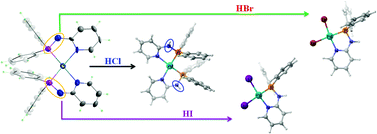
The reactivity and stability of P(III)–N and P(III)≈N bonds will be different towards various solvents, bases, and acids because of their difference in bond strength due to different N-pπ–P-dπ donor bonding. For this, a P≈N containing Pd(II) complex, [Pd(DPAP)2] (C1), was synthesized from the reaction between PdCl2(COD) (COD = 1,4-cyclooctadiene) and 2 equiv. DPAP (diphenyl phosphino amino pyridine) ligand, followed by deprotonation of the N–H proton of the coordinated DPAP. The reactivity and stability of coordinated P≈N in complex C1 were determined in various protic and aprotic solvents, bases, and acids. The inertness of coordinated P![[double bond, length as m-dash]](https://www.rsc.org/images/entities/char_e001.gif) N towards various solvents and bases was observed, whereas protonation occurs at the nitrogen of PN in the presence of an acid to form P–NH, with the generation of dicationic palladium complexes (C2). The dicationic complex C2 is found to be stable in the presence of bulky monoanionic Sn(IV) reagents, whereas, in the presence of more nucleophilic anions like Br? or I?, dissociation of one DPAP ligand from dicationic Pd(II) complexes C2 leads to the generation of Pd(DPAP)X2 (X = Br?, I?). Finally, the utility of the complexes towards Suzuki coupling of various aryl bromides and aryl or heteraryl boronic acids has been checked.
N towards various solvents and bases was observed, whereas protonation occurs at the nitrogen of PN in the presence of an acid to form P–NH, with the generation of dicationic palladium complexes (C2). The dicationic complex C2 is found to be stable in the presence of bulky monoanionic Sn(IV) reagents, whereas, in the presence of more nucleophilic anions like Br? or I?, dissociation of one DPAP ligand from dicationic Pd(II) complexes C2 leads to the generation of Pd(DPAP)X2 (X = Br?, I?). Finally, the utility of the complexes towards Suzuki coupling of various aryl bromides and aryl or heteraryl boronic acids has been checked.
Recommended Literature
- [1] Evolution and characterization of a benzylguanine-binding RNA aptamer? J. Xu,T. J. Carrocci,A. A. HoskinsChem. Commun., 2016,52, 549-552 10.1039/C5CC07605F
- [2] Excitation energies from ground-state density-functionals by means of generator coordinates A. B. F. da Silva,K. CapellePhys. Chem. Chem. Phys., 2009,11, 4564-4569 10.1039/B902529D
- [3] Excess electrons in lithium–ethylamine solutions—density, electrical conductivity and EPR studies Phys. Chem. Chem. Phys., 1999,1, 3561-3565 10.1039/A900683D
- [4] Evolution of hierarchical porous structures in supramolecular guest–host hydrogels? Christopher B. Rodell,Christopher B. Highley,Minna H. Chen,Neville N. Dusaj,Chao Wang,Lin Han,Jason A. BurdickSoft Matter, 2016,12, 7839-7847 10.1039/C6SM01395C
- [5] Fe3O4 nanosphere@microporous organic networks: enhanced anode performances in lithium ion batteries through carbonization? Byungho Lim,Jaewon Jin,Jin Yoo,Seung Yong Han,Kyeongyeol Kim,Sungah Kang,Nojin Park,Sang Moon Lee,Hae Jin Kim,Seung Uk SonChem. Commun., 2014,50, 7723-7726 10.1039/C4CC02068E
- [6] Fatty acid positional distribution in colostrum and mature milk of women living in Inner Mongolia, North Jiangsu and Guangxi of China? Long Deng,Qian Zou,Biao Liu,Wenhui Ye,Chengfei Zhuo,Li Chen,Ze-Yuan Deng,Ya-Wei Fan,Jing LiFood Funct., 2018,9, 4234-4245 10.1039/C8FO00787J
- [7] Dissociation of aryl sulfonyl phthalimide radical anions: relevance to the biological activity of arylsulfonyl amides? Abdelaziz Houmam,Emad M. HamedChem. Commun., 2012,48, 11328-11330 10.1039/C2CC36835H
- [8] Establishing new scaling relations on two-dimensional MXenes for CO2 electroreduction? Albertus D. Handoko,Khoong Hong Khoo,Teck Leong Tan,Hongmei Jin,Zhi Wei SehJ. Mater. Chem. A, 2018,6, 21885-21890 10.1039/C8TA06567E
- [9] Enabling shape memory and healable effects in a conjugated polymer by incorporating siloxane via dynamic imine bond? Yaling Zhang,Chunhui Dai,Shiwei Zhou,Bin LiuChem. Commun., 2018,54, 10092-10095 10.1039/C8CC05410J
- [10] Establishing plasmon contribution to chemical reactions: alkoxyamines as a thermal probe? Olga Guselnikova,Gérard Audran,Jean-Patrick Joly,Andrii Trelin,Evgeny V. Tretyakov,Vaclav Svorcik,Oleksiy Lyutakov,Sylvain R. A. MarqueChem. Sci., 2021,12, 4154-4161 10.1039/D0SC06470J

Journal Name:Dalton Transactions
research_products
-

CAS no.: 89640-58-4

![1,2,3,4,5,6-Hexahydro-[2,3]bipyridinyl-6-ol](https://ossimg.kuujia.com/scimg/1271000/1270529-38-8x500.png)


![N-(3-cyanothiolan-3-yl)-2-[(2,2,2-trifluoroethyl)sulfanyl]pyridine-4-carboxamide](https://ossimg.kuujia.com/scimg/1444500/1444113-98-7x500.png)

![2,2-Difluoro-3-[methyl(2-methylbutyl)amino]propanoic acid](https://ossimg.kuujia.com/scimg/2138500/2138166-62-6x500.png)

![2-(1H-indol-3-yl)-N-{[6-(thiophen-2-yl)-[1,2,4]triazolo[4,3-b]pyridazin-3-yl]methyl}acetamide](https://ossimg.kuujia.com/scimg/2034500/2034271-14-0x500.png)