Recent progress on fluorination in aqueous media
Green Chemistry Pub Date: 2017-07-10 DOI: 10.1039/C7GC01566F
Abstract
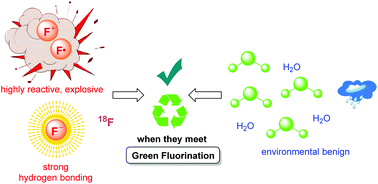
Advances in aqueous fluorination during the last few decades are summarized in this review. Fluorinated compounds have dominated a large percentage of agrochemicals and pharmaceuticals and a mass of functional materials. The incorporation of fluorine atoms into organic molecules has become one of the mainstream technologies for their functional modification. Water is very environmentally friendly and has advantageous physicochemical properties. Fluorination reactions in aqueous media are highly sought-after, and have attracted great attention in research areas ranging from medicinal chemistry to materials science. In early times and for a long time, fluorination was thought to be diametrically opposed to water or moisture. However, recent examples have conflicted with this viewpoint. The successful merger of “untamed” fluorine and “mild” water in chemical reactions has set up a new prospect for green chemistry. A considerable amount of remarkable research works have been carried out using water as a (co)solvent and/or a reactant for transformations including electrophilic, radical, or nucleophilic fluorination. We hope that this review will serve as a guide to better understand and to further broaden the field of fluorine chemistry in aqueous conditions.
Recommended Literature
- [1] An astrophysically-relevant mechanism for amino acid enantiomer enrichment Stephen P. Fletcher,Richard B. C. Jagt,Ben L. FeringaChem. Commun., 2007, 2578-2580 10.1039/B702882B
- [2] Acetyl group orientation modulates the electronic ground-state asymmetry of the special pair in purple bacterial reaction centers P. K. Wawrzyniak,M. T. P. Beerepoot,H. J. M. de Groot,F. BudaPhys. Chem. Chem. Phys., 2011,13, 10270-10279 10.1039/C1CP20213H
- [3] An anti-leakage liquid metal thermal interface material Kaiyuan Huang,Wangkang Qiu,Meilian Ou,Xiaorui Liu,Zenan Liao,Sheng ChuRSC Adv., 2020,10, 18824-18829 10.1039/D0RA02351E
- [4] An aptasensor for the detection of ampicillin in milk using a personal glucose meter Xixi Li,Nanwei Zhu,Ruohan Li,Qinpu ZhangAnal. Methods, 2020,12, 3376-3381 10.1039/D0AY00256A
- [5] An investigation of new infrared nonlinear optical material: BaCdSnSe4, and three new related centrosymmetric compounds: Ba2SnSe4, Mg2GeSe4, and Ba2Ge2S6? Kui Wu,Zhihua Yang,Shilie PanDalton Trans., 2015,44, 19856-19864 10.1039/C5DT03215F
- [6] An all-solid-state imprinted polymer-based potentiometric sensor for determination of bisphenol S? Rongning Liang,Tanji Yin,Ruiqing Yao,Wei QinRSC Adv., 2016,6, 73308-73312 10.1039/C6RA14461F
- [7] An atomically efficient, highly stable and redox active Ce0.5Tb0.5Ox (3% mol.)/MgO catalyst for total oxidation of methane? Juan J. Sánchez,Miguel López-Haro,Juan C. Hernández-Garrido,Ginesa Blanco,Miguel A. Cauqui,José M. Rodríguez-Izquierdo,José A. Pérez-Omil,José J. Calvino,María P. YesteJ. Mater. Chem. A, 2019,7, 8993-9003 10.1039/C8TA11672E
- [8] An assessment of strategies for the development of solid-state adsorbents for vehicular hydrogen storage Mark D. Allendorf,Alauddin Ahmed,Tom Autrey,Jeffrey Camp,Eun Seon Cho,Maciej Haranczyk,Abhi Karkamkar,Di-Jia Liu,Katie R. Meihaus,Iffat H. Nayyar,Roman Nazarov,Donald J. Siegel,Vitalie Stavila,Jeffrey J. Urban,Srimukh Prasad Veccham,Brandon C. WoodEnergy Environ. Sci., 2018,11, 2784-2812 10.1039/C8EE01085D
- [9] An amorphous Cu–In–S nanoparticle-based precursor ink with improved atom economy for CuInSe2 solar cells with 10.85% efficiency? Green Chem., 2017,19, 1268-1277 10.1039/C6GC03280J
- [10] An amplified fluorescence detection of T4 polynucleotide kinase activity based on coupled exonuclease III reaction and a graphene oxide platform? Ni-Na Sun,Fengli Qu,Xiaobing Zhang,Shufang Zhang,Jinmao YouAnalyst, 2015,140, 1827-1831 10.1039/C4AN01953A

Journal Name:Green Chemistry
research_products
-

CAS no.: 89640-58-4


![N-(3-cyanothiolan-3-yl)-2-[(2,2,2-trifluoroethyl)sulfanyl]pyridine-4-carboxamide](https://ossimg.kuujia.com/scimg/1444500/1444113-98-7x500.png)

![1,2,3,4,5,6-Hexahydro-[2,3]bipyridinyl-6-ol](https://ossimg.kuujia.com/scimg/1271000/1270529-38-8x500.png)

![2,2-Difluoro-3-[methyl(2-methylbutyl)amino]propanoic acid](https://ossimg.kuujia.com/scimg/2138500/2138166-62-6x500.png)

![2-(1H-indol-3-yl)-N-{[6-(thiophen-2-yl)-[1,2,4]triazolo[4,3-b]pyridazin-3-yl]methyl}acetamide](https://ossimg.kuujia.com/scimg/2034500/2034271-14-0x500.png)