Oxidative dehalogenation and denitration by a flavin-dependent monooxygenase is controlled by substrate deprotonation?
Chemical Science Pub Date: 2018-08-08 DOI: 10.1039/C8SC01482E
Abstract
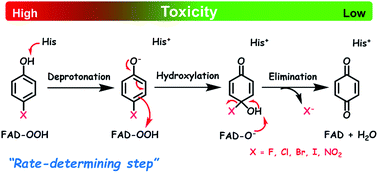
Enzymes that are capable of detoxifying halogenated phenols (HPs) and nitrophenols (NPs) are valuable for bioremediation and waste biorefining. HadA monooxygenase was found to perform dual functions of oxidative dehalogenation (hydroxylation plus halide elimination) and denitration (hydroxylation plus nitro elimination). Rate constants associated with individual steps of HadA reactions with phenol, halogenated phenols and nitrophenols were measured using combined transient kinetic approaches of stopped-flow absorbance/fluorescence and rapid-quench flow techniques. Density functional theory was used to calculate the thermodynamic and electronic parameters associated with hydroxylation and group elimination steps. These parameters were correlated with the rate constants of hydroxylation, group elimination, and overall product formation to identify factors controlling individual steps. The results indicated that the hydroxylation rate constant is higher when the pKa of the phenolic group is lower, i.e. it is more easily deprotonated, but not higher when the energy gap between the ELUMO of the C4a-hydroperoxy-FAD intermediate and the EHOMO of the phenolate substrate is lower. These data suggest that the substrate deprotonation has a higher energy barrier than the –OH transfer, and thus controls the hydroxylation step. For the group elimination, the process is controlled by the ability of the C–X bond to break. For the overall product formation (hydroxylation and group elimination combined), this analysis showed that the rate constant of product formation is dependent on the pKa value of the substrate, indicating that the overall reaction is controlled by substrate deprotonation. This step also likely has the highest energy barrier and thus controls the overall process of oxidative dehalogenation and denitration by HadA. This report is the first to identify a key mechanistic factor controlling the enzymatic processes of oxidative dehalogenation and denitration.
Recommended Literature
- [1] Establishment and implications of a characterization method for magnetic nanoparticle using cell tracking velocimetry and magnetic susceptibility modified solutions Huading Zhang,Lee R. Moore,Maciej Zborowski,P. Stephen Williams,Shlomo Margel,Jeffrey J. ChalmersAnalyst, 2005,130, 514-527 10.1039/B412723D
- [2] Emerging investigator series: first-principles and thermodynamics comparison of compositionally-tuned delafossites: cation release from the (001) surface of complex metal oxides? Joseph W. Bennett,Diamond T. Jones,Blake G. Hudson,Joshua Melendez-Rivera,Robert J. Hamers,Sara E. MasonEnviron. Sci.: Nano, 2020,7, 1642-1651 10.1039/C9EN01304K
- [3] Establishing new scaling relations on two-dimensional MXenes for CO2 electroreduction? Albertus D. Handoko,Khoong Hong Khoo,Teck Leong Tan,Hongmei Jin,Zhi Wei SehJ. Mater. Chem. A, 2018,6, 21885-21890 10.1039/C8TA06567E
- [4] Establishing plasmon contribution to chemical reactions: alkoxyamines as a thermal probe? Olga Guselnikova,Gérard Audran,Jean-Patrick Joly,Andrii Trelin,Evgeny V. Tretyakov,Vaclav Svorcik,Oleksiy Lyutakov,Sylvain R. A. MarqueChem. Sci., 2021,12, 4154-4161 10.1039/D0SC06470J
- [5] Excellent humidity sensor based on ultrathin HKUST-1 nanosheets? Qiaoe Wang,Meiling Lian,Xiaowen Zhu,Xu ChenRSC Adv., 2021,11, 192-197 10.1039/D0RA08354B
- [6] Fe(iii)-mediated isomerization of α,α-diarylallylic alcohols to ketones via radical 1,2-aryl migration? Ziyang Deng,Changwei Chen,Sunliang CuiRSC Adv., 2016,6, 93753-93755 10.1039/C6RA20007A
- [7] Esterase-responsive polymeric prodrug-based tumor targeting nanoparticles for improved anti-tumor performance against colon cancer? Gang Pan,Yi-jie Bao,Jie Xu,Tao Liu,Cheng Liu,Yan-yan Qiu,Xiao-jing Shi,Hui Yu,Ting-ting Jia,Xia Yuan,Ze-ting Yuan,Yi-jun CaoRSC Adv., 2016,6, 42109-42119 10.1039/C6RA05236C
- [8] Excellent kinetics of single-phase Gd-doped ceria fuel electrodes in solid oxide cells? Andreas Nenning,Manuel Holzmann,Jürgen Fleig,Alexander K. OpitzMater. Adv., 2021,2, 5422-5431 10.1039/D1MA00202C
- [9] Fatty acid eutectic mixtures and derivatives from non-edible animal fat as phase change materials? Pau Gallart-Sirvent,Marc Martín,Gemma Villorbina,Mercè Balcells,Aran Solé,Luisa F. Cabeza,Ramon Canela-GarayoaRSC Adv., 2017,7, 24133-24139 10.1039/C7RA03845C
- [10] Evolution in surface coverage of CH3NH3PbI3?XClXvia heat assisted solvent vapour treatment and their effects on photovoltaic performance of devices Dhirendra K. Chaudhary,Pramendra Kumar,Lokendra KumarRSC Adv., 2016,6, 94731-94738 10.1039/C6RA18729C

Journal Name:Chemical Science
research_products
-

CAS no.: 89640-58-4

![1,2,3,4,5,6-Hexahydro-[2,3]bipyridinyl-6-ol](https://ossimg.kuujia.com/scimg/1271000/1270529-38-8x500.png)


![N-(3-cyanothiolan-3-yl)-2-[(2,2,2-trifluoroethyl)sulfanyl]pyridine-4-carboxamide](https://ossimg.kuujia.com/scimg/1444500/1444113-98-7x500.png)

![2,2-Difluoro-3-[methyl(2-methylbutyl)amino]propanoic acid](https://ossimg.kuujia.com/scimg/2138500/2138166-62-6x500.png)

![2-(1H-indol-3-yl)-N-{[6-(thiophen-2-yl)-[1,2,4]triazolo[4,3-b]pyridazin-3-yl]methyl}acetamide](https://ossimg.kuujia.com/scimg/2034500/2034271-14-0x500.png)