Quantifying the efficacy of diquat dibromide in controlling Microcystis aeruginosa and Aphanizomenon flos-aquae in comparison to copper sulfate and potassium permanganate?
Environmental Science: Water Research & Technology Pub Date: 2018-11-28 DOI: 10.1039/C8EW00532J
Abstract
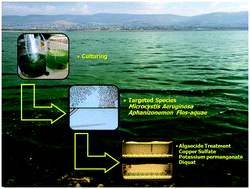
Cyanobacterial harmful algal blooms (HABs) are an emerging problem worldwide, affecting many important freshwater systems. The use of chemical algaecides can provide an effective short-term mitigation measure to control HABs. In this study, the efficacy of diquat dibromide was examined under laboratory conditions to control two problematic toxin-releasing cyanobacteria, namely Aphanizomenon flos-aquae and Microcystis aeruginosa. Its performance was then compared to that of copper sulfate (CuSO4) and potassium permanganate (KMnO4), two commonly used algaecides. The results suggest that while all three algaecides were effective in controlling Aphanizomenon, the highest inhibition rates achieved were associated with the application of diquat dibromide. Aphanizomenon exhibited a half-life of 0.48 days with diquat dibromide dosages of 0.5 and 1 mg L?1. Both diquat dibromide and CuSO4 exhibited more effectiveness in controlling Microcystis aeruginosa as compared to KMnO4. Reductions achieved by applying 0.5 mg L?1 of diquat dibromide or 1 mg L?1 of CuSO4 exceeded 95% after 48 h of treatment. Nevertheless, diquat dibromide suppressed the net regrowth of Microcystis aeruginosa up to 70 h, while suppression with CuSO4 did not exceed 64 h even with the highest applied dosage. Irrespective of the algaecide and the application dosage, regrowth was observed for Microcystis aeruginosa but not for Aphanizomenon flos-aquae. Statistical models were proposed to simulate inhibition rates and estimate net algal regeneration.
Recommended Literature
- [1] Fe3O4/PEG-SO3H as a heterogeneous and magnetically-recyclable nanocatalyst for the oxidation of sulfides to sulfones or sulfoxides Saeideh Mirfakhraei,Malak Hekmati,Fereshteh Hosseini Eshbala,Hojat VeisiNew J. Chem., 2018,42, 1757-1761 10.1039/C7NJ02513K
- [2] Excellent energy storage performance in NaNbO3-based relaxor antiferroeic ceramics under a low electric field XuxinCheng,XiaomingChen,PengyuanFan 10.1007/s10832-022-00283-w
- [3] Excitation dependent bidirectional electron transfer in phthalocyanine-functionalised MoS2 nanosheets? Christopher J. Harrison,Kyle J. Berean,Enrico Della Gaspera,Jian Zhen Ou,Richard B. Kaner,Kourosh Kalantar-zadeh,Torben DaenekeNanoscale, 2016,8, 16276-16283 10.1039/C6NR04326G
- [4] Feasibility of polyethylene composites reinforced by distillers dried fibers with solubles (DDFS) after different generations of ethanol fermentation? Bo Chen,Xiaotong Shen,Zhangfeng Luo,Di Cai,Changjing Chen,Changwei Zhang,Peiyong Qin,Hui Cao,Tianwei TanRSC Adv., 2018,8, 25602-25610 10.1039/C8RA03906B
- [5] Excited state character of Cibalackrot-type compounds interpreted in terms of Hückel-aromaticity: a rationale for singlet fission chromophore design? Weixuan Zeng,Ouissam El Bakouri,Henrik OttossonChem. Sci., 2021,12, 6159-6171 10.1039/D1SC00382H
- [6] Fe3O4/Au/Fe3O4 nanoflowers exhibiting tunable saturation magnetization and enhanced bioconjugation Feng Shi,Kunping Yan,Mingli Peng,Xiao Cheng,Yanling Luo,Xuemei Chen,V. A. L. Roy,Zuankai WangNanoscale, 2012,4, 747-751 10.1039/C2NR11489E
- [7] Essential effect of the electrolyte on the mechanical and chemical degradation of LiNi0.8Co0.15Al0.05O2 cathodes upon long-term cycling?? Xiaoming Liu,Zachary D. Hood,Wangda Li,Donovan N. Leonard,Arumugam Manthiram,Miaofang ChiJ. Mater. Chem. A, 2021,9, 2111-2119 10.1039/D0TA07814J
- [8] Evolution of cellulose into flexible conductive green electronics: a smart strategy to fabricate sustainable electrodes for supercapacitors Tengfei Yu,Yuehan Wu,Wei Li,Bin LiRSC Adv., 2014,4, 34134-34143 10.1039/C4RA07017H
- [9] Evolution of calcium phosphate precipitation in hanging drop vapor diffusion by in situRaman microspectroscopy Gloria Belén Ramírez-Rodríguez,José Manuel Delgado-López,Jaime Gómez-MoralesCrystEngComm, 2013,15, 2206-2212 10.1039/C2CE26556G
- [10] Distinctive size effects of Pt nanoparticles immobilized on Fe3O4@PPy used as an efficient recyclable catalyst for benzylic alcohol aerobic oxidation and hydrogenation reduction of nitroaromatics Yu Long,Bing Yuan,Jianrui Niu,Xin Tong,Jiantai MaNew J. Chem., 2015,39, 1179-1185 10.1039/C4NJ01869A

Journal Name:Environmental Science: Water Research & Technology
research_products
-

CAS no.: 89640-58-4

![1,2,3,4,5,6-Hexahydro-[2,3]bipyridinyl-6-ol](https://ossimg.kuujia.com/scimg/1271000/1270529-38-8x500.png)


![N-(3-cyanothiolan-3-yl)-2-[(2,2,2-trifluoroethyl)sulfanyl]pyridine-4-carboxamide](https://ossimg.kuujia.com/scimg/1444500/1444113-98-7x500.png)

![2,2-Difluoro-3-[methyl(2-methylbutyl)amino]propanoic acid](https://ossimg.kuujia.com/scimg/2138500/2138166-62-6x500.png)

![2-(1H-indol-3-yl)-N-{[6-(thiophen-2-yl)-[1,2,4]triazolo[4,3-b]pyridazin-3-yl]methyl}acetamide](https://ossimg.kuujia.com/scimg/2034500/2034271-14-0x500.png)