Large polarization and record-high performance of energy storage induced by a phase change in organic molecular crystals?
Chemical Science Pub Date: 2021-10-06 DOI: 10.1039/D1SC02729H
Abstract
Dielectrics that undergo electric-field-induced phase changes are promising for use as high-power electrical energy storage materials and transducers. We demonstrate the stepwise on/off switching of large polarization in a series of dielectrics by flipping their antipolar or canted electric dipoles via proton transfer and inducing simultaneous geometric changes in their π-conjugation system. Among antiferroelectric organic molecular crystals, the largest-magnitude polarization jump was obtained as 18 μC cm?2 through revisited measurements of squaric acid (SQA) crystals with improved dielectric strength. The second-best polarization jump of 15.1 μC cm?2 was achieved with a newly discovered antiferroelectric, furan-3,4-dicarboxylic acid. The field-induced dielectric phase changes show rich variations in their mechanisms. The quadruple polarization hysteresis loop observed for a 3-(4-chlorophenyl)propiolic acid crystal was caused by a two-step phase transition with moderate polarization jumps. The ferroelectric 2-phenylmalondialdehyde single crystal having canted dipoles behaved as an amphoteric dielectric, exhibiting a single or double polarization hysteresis loop depending on the direction of the external field. The magnitude of a series of observed polarizations was consistently reproduced within the simplest sublattice model by the density functional theory calculations of dipole moments flipping over a hydrogen-bonded chain or sheet (sublattice) irrespective of compounds. This finding guarantees a tool that will deepen our understanding of the microscopic phase-change mechanisms and accelerate the materials design and exploration for improving energy-storage performance. The excellent energy-storage performance of SQA was demonstrated by both a high recoverable energy-storage density Wr of 3.3 J cm?3 and a nearly ideal efficiency (90%). Because of the low crystal density, the corresponding energy density per mass  (1.75 J g?1) exceeded those derived from the highest Wr values (~8–11 J cm?3) reported for several bulk antiferroelectric ceramics
 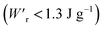 , without modification to relaxor forms.

Recommended Literature
- [1] Excitation energies from ground-state density-functionals by means of generator coordinates A. B. F. da Silva,K. CapellePhys. Chem. Chem. Phys., 2009,11, 4564-4569 10.1039/B902529D
- [2] Evidence of CO2 molecule acting as an electron acceptor on a nanoporous metal–organic-framework MIL-53 or Cr3+(OH)(O2C–C6H4–CO2)? Alexandre Vimont,Arnaud Travert,Philippe Bazin,Jean-Claude Lavalley,Marco Daturi,Christian Serre,Gérard Férey,Sandrine Bourrelly,Philip L. LlewellynChem. Commun., 2007, 3291-3293 10.1039/B703468G
- [3] Fate of Sb(v) and Sb(iii) species along a gradient of pH and oxygen concentration in the Carnoulès mine waters (Southern France) Eléonore Resongles,Corinne Casiot,Fran?oise Elbaz-Poulichet,Rémi Freydier,Odile Bruneel,Christine Piot,Sophie Delpoux,Aurélie Volant,Angélique DesoeuvreEnviron. Sci.: Processes Impacts, 2013,15, 1536-1544 10.1039/C3EM00215B
- [4] Emulsifier-free, organotellurium-mediated living radical emulsion polymerization (emulsion TERP) of styrene: poly(dimethylaminoethyl methacrylate) macro-TERP agent? Yukiya KitayamaPolym. Chem., 2014,5, 2784-2792 10.1039/C3PY01539D
- [5] Fe/Fe3C@C nanoparticles encapsulated in N-doped graphene–CNTs framework as an efficient bifunctional oxygen electrocatalyst for robust rechargeable Zn–air batteries? Zhiyan Chen,Nan Wu,Yaobing Wang,Bing Wang,Yingde WangJ. Mater. Chem. A, 2018,6, 516-526 10.1039/C7TA08423D
- [6] Evidence that the availability of an allylic hydrogen governs the regioselectivity of the Wacker oxidation Matthew J. Gaunt,Jinquan Yu,Jonathan B. SpencerChem. Commun., 2001, 1844-1845 10.1039/B103066N
- [7] Evolution of cellulose into flexible conductive green electronics: a smart strategy to fabricate sustainable electrodes for supercapacitors Tengfei Yu,Yuehan Wu,Wei Li,Bin LiRSC Adv., 2014,4, 34134-34143 10.1039/C4RA07017H
- [8] Excited state dynamics of symmetric and asymmetric Cr3(dpa)4Cl2 measured using femtosecond transient absorption spectroscopy? Chao-Han Cheng,Wen-Zhen Wang,Shie-Ming Peng,I-Chia ChenPhys. Chem. Chem. Phys., 2017,19, 25471-25477 10.1039/C7CP03968A
- [9] Excitation dependent bidirectional electron transfer in phthalocyanine-functionalised MoS2 nanosheets? Christopher J. Harrison,Kyle J. Berean,Enrico Della Gaspera,Jian Zhen Ou,Richard B. Kaner,Kourosh Kalantar-zadeh,Torben DaenekeNanoscale, 2016,8, 16276-16283 10.1039/C6NR04326G
- [10] Excitable dynamics in the bromate–sulfite–ferrocyanide reaction J. Zagora,M. Vosla?,L. Schreiberová,I. SchreiberPhys. Chem. Chem. Phys., 2002,4, 1284-1291 10.1039/B110048C

Journal Name:Chemical Science
research_products
-

CAS no.: 89640-58-4

![1,2,3,4,5,6-Hexahydro-[2,3]bipyridinyl-6-ol](https://ossimg.kuujia.com/scimg/1271000/1270529-38-8x500.png)


![N-(3-cyanothiolan-3-yl)-2-[(2,2,2-trifluoroethyl)sulfanyl]pyridine-4-carboxamide](https://ossimg.kuujia.com/scimg/1444500/1444113-98-7x500.png)

![2,2-Difluoro-3-[methyl(2-methylbutyl)amino]propanoic acid](https://ossimg.kuujia.com/scimg/2138500/2138166-62-6x500.png)

![2-(1H-indol-3-yl)-N-{[6-(thiophen-2-yl)-[1,2,4]triazolo[4,3-b]pyridazin-3-yl]methyl}acetamide](https://ossimg.kuujia.com/scimg/2034500/2034271-14-0x500.png)