Interfacial sciences in unconventional petroleum production: from fundamentals to applications
Chemical Society Reviews Pub Date: 2015-05-19 DOI: 10.1039/C5CS00102A
Abstract
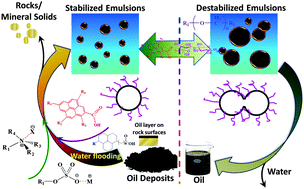
With the ever increasing demand for energy to meet the needs of growth in population and improvement in the living standards in particular in developing countries, the abundant unconventional oil reserves (about 70% of total world oil), such as heavy oil, oil/tar sands and shale oil, are playing an increasingly important role in securing global energy supply. Compared with the conventional reserves unconventional oil reserves are characterized by extremely high viscosity and density, combined with complex chemistry. As a result, petroleum production from unconventional oil reserves is much more difficult and costly with more serious environmental impacts. As a key underpinning science, understanding the interfacial phenomena involved in unconventional petroleum production, such as oil liberation from host rocks, oil–water emulsions and demulsification, is critical for developing novel processes to improve oil production while reducing GHG emission and other environmental impacts at a lower operating cost. In the past decade, significant efforts and advances have been made in applying the principles of interfacial sciences to better understand complex unconventional oil-systems, while many environmental and production challenges remain. In this critical review, the recent research findings and progress in the interfacial sciences related to unconventional petroleum production are critically reviewed. In particular, the chemistry of unconventional oils, liberation mechanisms of oil from host rocks and mechanisms of emulsion stability and destabilization in unconventional oil production systems are discussed in detail. This review also seeks to summarize the current state-of-the-art characterization techniques and brings forward the challenges and opportunities for future research in this important field of physical chemistry and petroleum.
Recommended Literature
- [1] Emerging investigator series: first-principles and thermodynamics comparison of compositionally-tuned delafossites: cation release from the (001) surface of complex metal oxides? Joseph W. Bennett,Diamond T. Jones,Blake G. Hudson,Joshua Melendez-Rivera,Robert J. Hamers,Sara E. MasonEnviron. Sci.: Nano, 2020,7, 1642-1651 10.1039/C9EN01304K
- [2] Emerging investigators Polym. Chem., 2015,6, 5501-5502 10.1039/C5PY90111A
- [3] Dissociative electron attachment to HGaF4 Lewis–Br?nsted superacid Marcin Czapla,Jack SimonsPhys. Chem. Chem. Phys., 2018,20, 21739-21745 10.1039/C8CP04007A
- [4] Enabling stable MnO2 matrix for aqueous zinc-ion battery cathodes? Yiding Jiao,Liqun Kang,Jasper Berry-Gair,Kit McColl,Jianwei Li,Haobo Dong,Hao Jiang,Ryan Wang,Furio Corà,Dan J. L. Brett,Ivan P. ParkinJ. Mater. Chem. A, 2020,8, 22075-22082 10.1039/D0TA08638J
- [5] Excellent humidity sensor based on ultrathin HKUST-1 nanosheets? Qiaoe Wang,Meiling Lian,Xiaowen Zhu,Xu ChenRSC Adv., 2021,11, 192-197 10.1039/D0RA08354B
- [6] Excellent energy storage performance in NaNbO3-based relaxor antiferroeic ceramics under a low electric field XuxinCheng,XiaomingChen,PengyuanFan 10.1007/s10832-022-00283-w
- [7] Fe(ii)-Assisted one-pot synthesis of ultra-small core–shell Au–Pt nanoparticles as superior catalysts towards the HER and ORR? Yi Cao,Yujiao Xiahou,Lixiang Xing,Xiang Zhang,Hong Li,ChenShou Wu,Haibing XiaNanoscale, 2020,12, 20456-20466 10.1039/D0NR04995F
- [8] Excellent peroxidase mimicking property of CuO/Pt nanocomposites and their application as an ascorbic acid sensor? Xinhuan Wang,Shuangfei Cai,Cui QiAnalyst, 2017,142, 2500-2506 10.1039/C7AN00589J
- [9] Evidence of rutile-to-anatase photo-induced electron transfer in mixed-phase TiO2 by solid-state NMR spectroscopy? Weili Dai,Guangjun Wu,Michael HungerChem. Commun., 2015,51, 13779-13782 10.1039/C5CC04971G
- [10] Embedding heteroatoms: an effective approach to create porphyrin-based functional materials Norihito Fukui,Keisuke Fujimoto,Hideki Yorimitsu,Atsuhiro OsukaDalton Trans., 2017,46, 13322-13341 10.1039/C7DT02815F

Journal Name:Chemical Society Reviews
research_products
-

CAS no.: 89640-58-4

![1,2,3,4,5,6-Hexahydro-[2,3]bipyridinyl-6-ol](https://ossimg.kuujia.com/scimg/1271000/1270529-38-8x500.png)


![N-(3-cyanothiolan-3-yl)-2-[(2,2,2-trifluoroethyl)sulfanyl]pyridine-4-carboxamide](https://ossimg.kuujia.com/scimg/1444500/1444113-98-7x500.png)

![2,2-Difluoro-3-[methyl(2-methylbutyl)amino]propanoic acid](https://ossimg.kuujia.com/scimg/2138500/2138166-62-6x500.png)

![2-(1H-indol-3-yl)-N-{[6-(thiophen-2-yl)-[1,2,4]triazolo[4,3-b]pyridazin-3-yl]methyl}acetamide](https://ossimg.kuujia.com/scimg/2034500/2034271-14-0x500.png)