A novel cell membrane-cloaked magnetic nanogripper with enhanced stability for drug discovery?
Biomaterials Science Pub Date: 2019-11-12 DOI: 10.1039/C9BM01411J
Abstract
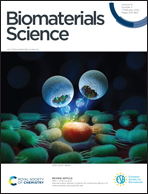
Cell membrane-cloaked nanotechnology has attracted increasing attention owing to its unique bionic properties, such as specific recognition and biocompatibility conferred by the integrated membrane structure and receptors. However, this technology is limited by the dissociation of the cell membrane from its carrier. Here, we report a novel type of cell membrane-cloaked modified magnetic nanoparticle with good stability in drug discovery. High α1A-adrenergic receptor (α1A-AR) expressing HEK293 cell membrane-cloaked magnetic nanogrippers (α1A/MNGs) were used as a platform for the specific targeting and binding of α1A-AR antagonists as candidate bioactive compounds from traditional Chinese medicine (TCM). Furthermore, using a dynamic covalent bonding approach, α1A/MNGs showed great stability with positive control drug recoveries of α1A/MNGs showing almost no decline after use in five adsorption–desorption cycles. Moreover, the α1A/MNGs possessed a unilamellar membrane with magnetic features and exhibited good binding capacity and selectivity. Ultimately, TCM and pharmacological studies of the bioactivity of the screened compounds confirmed the considerable targeting and binding capability of α1A/MNGs. Application of aldehyde group modification in this drug-targeting concept further improved biomaterial stability and paves the way for the development of new drug discovery strategies. More importantly, the successful application of α1A/MNGs provides new insights into methodologies to improve the integration of cell membranes with the nanoparticle platform.

Recommended Literature
- [1] Excellent mechanical performance and enhanced dielectric properties of OBC/SiO2 elastomeric nanocomposites: effect of dispersion of the SiO2 nanoparticles? Xing Zhao,Lu Bai,Rui-Ying Bao,Zheng-Ying Liu,Ming-Bo Yang,Wei YangRSC Adv., 2017,7, 46297-46305 10.1039/C7RA08074C
- [2] Exceptional activity of sub-nm Pt clusters on CdS for photocatalytic hydrogen production: a combined experimental and first-principles study? Qiyuan Wu,Shangmin Xiong,Peichuan Shen,Shen Zhao,Alexander OrlovCatal. Sci. Technol., 2015,5, 2059-2064 10.1039/C4CY01563K
- [3] Establishment and implications of a characterization method for magnetic nanoparticle using cell tracking velocimetry and magnetic susceptibility modified solutions Huading Zhang,Lee R. Moore,Maciej Zborowski,P. Stephen Williams,Shlomo Margel,Jeffrey J. ChalmersAnalyst, 2005,130, 514-527 10.1039/B412723D
- [4] Fe3O4 nanosphere@microporous organic networks: enhanced anode performances in lithium ion batteries through carbonization? Byungho Lim,Jaewon Jin,Jin Yoo,Seung Yong Han,Kyeongyeol Kim,Sungah Kang,Nojin Park,Sang Moon Lee,Hae Jin Kim,Seung Uk SonChem. Commun., 2014,50, 7723-7726 10.1039/C4CC02068E
- [5] Fe3O4/PEG-SO3H as a heterogeneous and magnetically-recyclable nanocatalyst for the oxidation of sulfides to sulfones or sulfoxides Saeideh Mirfakhraei,Malak Hekmati,Fereshteh Hosseini Eshbala,Hojat VeisiNew J. Chem., 2018,42, 1757-1761 10.1039/C7NJ02513K
- [6] Estimation of activation energy for electroporation and pore growth rate in liquid crystalline and gel phases of lipid bilayers using molecular dynamics simulations? Amit Kumar Majhi,Subbarao Kanchi,V. Venkataraman,K. G. Ayappa,Prabal K. MaitiSoft Matter, 2015,11, 8632-8640 10.1039/C5SM02029H
- [7] Distributed research: a new paradigm for undergraduate research and global problem solving? Bruce ParkinsonEnergy Environ. Sci., 2010,3, 509-511 10.1039/B919523H
- [8] Fe3O4@PANI: a magnetic polyaniline nanomaterial for highly efficient and handy enrichment of intact N-glycopeptides?? Zhizhen Lai,Mo Zhang,Jinyu Zhou,Tianjing Chen,Dan Li,Xuejing Shen,Jia Liu,Jiang Zhou,Zhili LiAnalyst, 2021,146, 4261-4267 10.1039/D1AN00580D
- [9] Fe3O4 nanoparticle chains with N-doped carbon coating: magnetotactic bacteria assisted synthesis and high-rate lithium storage? Dan Yang,Yanping Zhou,Xianhong Rui,Jixin Zhu,Ziyang Lu,Eileen Fong,Qingyu YanRSC Adv., 2013,3, 14960-14962 10.1039/C3RA42116C
- [10] Esterase-responsive polymeric prodrug-based tumor targeting nanoparticles for improved anti-tumor performance against colon cancer? Gang Pan,Yi-jie Bao,Jie Xu,Tao Liu,Cheng Liu,Yan-yan Qiu,Xiao-jing Shi,Hui Yu,Ting-ting Jia,Xia Yuan,Ze-ting Yuan,Yi-jun CaoRSC Adv., 2016,6, 42109-42119 10.1039/C6RA05236C
Journal Name:Biomaterials Science
research_products
-

CAS no.: 89640-58-4

![1,2,3,4,5,6-Hexahydro-[2,3]bipyridinyl-6-ol](https://ossimg.kuujia.com/scimg/1271000/1270529-38-8x500.png)


![N-(3-cyanothiolan-3-yl)-2-[(2,2,2-trifluoroethyl)sulfanyl]pyridine-4-carboxamide](https://ossimg.kuujia.com/scimg/1444500/1444113-98-7x500.png)

![2,2-Difluoro-3-[methyl(2-methylbutyl)amino]propanoic acid](https://ossimg.kuujia.com/scimg/2138500/2138166-62-6x500.png)

![2-(1H-indol-3-yl)-N-{[6-(thiophen-2-yl)-[1,2,4]triazolo[4,3-b]pyridazin-3-yl]methyl}acetamide](https://ossimg.kuujia.com/scimg/2034500/2034271-14-0x500.png)