Microwave-assisted deep eutectic solvent extraction coupled with headspace solid-phase microextraction followed by GC-MS for the analysis of volatile compounds from tobacco?
Analytical Methods Pub Date: 2016-12-26 DOI: 10.1039/C6AY03076A
Abstract
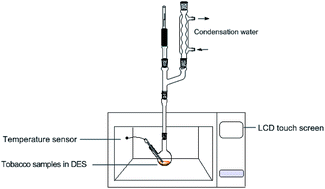
A novel method of microwave-assisted deep eutectic solvent extraction coupled with solid-phase microextraction was developed to determine the volatile compounds in tobacco by gas chromatography-mass spectrometry. During the process, the deep eutectic solvent played the roles of absorbing medium for microwave radiation, destroyer of cell walls, and solvent for dissolving the compounds released from the cells. Combined with solid-phase microextraction, the volatile components were extracted and concentrated in one step. In this method, several experimental parameters, such as fibre type, deep eutectic solvent type, microwave power, set-up temperature and irradiation time were studied. Compared with microwave-assisted water extraction coupled with solid-phase microextraction, and conventional solid-phase microextraction, more volatile components were obtained with higher responses. It was demonstrated that this method has improved extraction efficiency. Moreover, the proposed method has been applied to analyzing tobacco volatiles from different regions and nine different types of components have been detected. The results indicate that microwave-assisted deep eutectic solvent extraction coupled with solid-phase microextraction is an efficient, environmentally-friendly and fast miniaturization pretreatment technology for the extraction of volatiles from tobacco samples. This is a potentially promising technique for other complex and valuable matrices with low volatile content.
Recommended Literature
- [1] Emerging 2D hybrid nanomaterials: towards enhanced sensitive and selective conductometric gas sensors at room temperature Hanie Hashtroudi,Ian D. R. MackinnonJ. Mater. Chem. C, 2020,8, 13108-13126 10.1039/D0TC01968B
- [2] Examination of the hydrogen-bonding networks in small water clusters (n = 2–5, 13, 17) using absolutely localized molecular orbital energy decomposition analysis? Erika A. Cobar,Paul R. Horn,Robert G. Bergman,Martin Head-GordonPhys. Chem. Chem. Phys., 2012,14, 15328-15339 10.1039/C2CP42522J
- [3] Exchanged ligands on the surface of a giant cluster: [(MoO3)176(H2O)63(CH3OH)17Hn](32 – n)– Chem. Commun., 1998, 1501-1502 10.1039/A801804I
- [4] Enabling stable MnO2 matrix for aqueous zinc-ion battery cathodes? Yiding Jiao,Liqun Kang,Jasper Berry-Gair,Kit McColl,Jianwei Li,Haobo Dong,Hao Jiang,Ryan Wang,Furio Corà,Dan J. L. Brett,Ivan P. ParkinJ. Mater. Chem. A, 2020,8, 22075-22082 10.1039/D0TA08638J
- [5] Exceptional activity of sub-nm Pt clusters on CdS for photocatalytic hydrogen production: a combined experimental and first-principles study? Qiyuan Wu,Shangmin Xiong,Peichuan Shen,Shen Zhao,Alexander OrlovCatal. Sci. Technol., 2015,5, 2059-2064 10.1039/C4CY01563K
- [6] Fatty acid positional distribution in colostrum and mature milk of women living in Inner Mongolia, North Jiangsu and Guangxi of China? Long Deng,Qian Zou,Biao Liu,Wenhui Ye,Chengfei Zhuo,Li Chen,Ze-Yuan Deng,Ya-Wei Fan,Jing LiFood Funct., 2018,9, 4234-4245 10.1039/C8FO00787J
- [7] Excellent humidity sensor based on ultrathin HKUST-1 nanosheets? Qiaoe Wang,Meiling Lian,Xiaowen Zhu,Xu ChenRSC Adv., 2021,11, 192-197 10.1039/D0RA08354B
- [8] Excimer emission and magnetoluminescence of radical-based zinc(ii) complexes doped in host crystals? Shojiro Kimura,Tetsuro KusamotoChem. Commun., 2020,56, 11195-11198 10.1039/D0CC04830E
- [9] Fe/Fe3C@C nanoparticles encapsulated in N-doped graphene–CNTs framework as an efficient bifunctional oxygen electrocatalyst for robust rechargeable Zn–air batteries? Zhiyan Chen,Nan Wu,Yaobing Wang,Bing Wang,Yingde WangJ. Mater. Chem. A, 2018,6, 516-526 10.1039/C7TA08423D
- [10] Establishing plasmon contribution to chemical reactions: alkoxyamines as a thermal probe? Olga Guselnikova,Gérard Audran,Jean-Patrick Joly,Andrii Trelin,Evgeny V. Tretyakov,Vaclav Svorcik,Oleksiy Lyutakov,Sylvain R. A. MarqueChem. Sci., 2021,12, 4154-4161 10.1039/D0SC06470J

Journal Name:Analytical Methods
research_products
-

CAS no.: 89640-58-4


![N-(3-cyanothiolan-3-yl)-2-[(2,2,2-trifluoroethyl)sulfanyl]pyridine-4-carboxamide](https://ossimg.kuujia.com/scimg/1444500/1444113-98-7x500.png)

![1,2,3,4,5,6-Hexahydro-[2,3]bipyridinyl-6-ol](https://ossimg.kuujia.com/scimg/1271000/1270529-38-8x500.png)

![2,2-Difluoro-3-[methyl(2-methylbutyl)amino]propanoic acid](https://ossimg.kuujia.com/scimg/2138500/2138166-62-6x500.png)

![2-(1H-indol-3-yl)-N-{[6-(thiophen-2-yl)-[1,2,4]triazolo[4,3-b]pyridazin-3-yl]methyl}acetamide](https://ossimg.kuujia.com/scimg/2034500/2034271-14-0x500.png)