Microbial diversity and flavor formation in onion fermentation
Food & Function Pub Date: 2014-07-14 DOI: 10.1039/C4FO00196F
Abstract
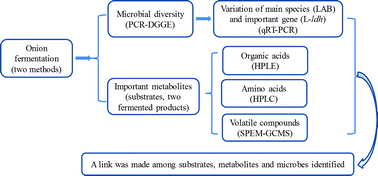
Fermented onion products are popular in many countries. We conducted fermentation with and without salt to identify the microorganisms responsible for onion fermentation and the unique taste of fermented onion. The results of PCR-DGGE (polymerase chain reaction-denaturing gradient gel electrophoresis) revealed that lactic acid bacteria (Lactobacillus zymae, L. malefermentans, L. plantarum), acetic acid bacteria (Acetobacter pasteurianus, A. orientalis), citric acid bacteria (Citrobacter sp., C. freundii), and yeasts (Candida humilis, Kazachstania exigua, Saccharomyces boulardii) were the dominant microorganisms involved in onion fermentation. Organic acid analysis indicated that lactic acid and acetic acid significantly increased after fermentation. There were no significant changes in the types of amino acids after fermentation, but the total concentration of amino acids significantly decreased after fermentation with salt. The increase in esters, alcohols, and aldehydes after fermentation was responsible for the unique flavor of fermented onion. Fermentation with salt inhibited the accumulation of organic acids and limited the conversion of proteins into amino acids but maintained the unique odor of onion by limiting the degradation of sulfur-containing compounds.
Recommended Literature
- [1] An integrated digital microfluidic chip for multiplexed proteomic sample preparation and analysis by MALDI-MS? Hyejin Moon,Aaron R. Wheeler,Robin L. Garrell,Chang-Jin “CJ” KimLab Chip, 2006,6, 1213-1219 10.1039/B601954D
- [2] An amorphous Cu–In–S nanoparticle-based precursor ink with improved atom economy for CuInSe2 solar cells with 10.85% efficiency? Green Chem., 2017,19, 1268-1277 10.1039/C6GC03280J
- [3] An amorphous carbon nitride/NiO/CoN-based composite: a highly efficient nonprecious electrode for supercapacitors and the oxygen evolution reaction? Huifang Yang,Haoran Guo,Peidong Fan,Xinpan Li,Wenlu Ren,Rui SongNanoscale, 2020,12, 7024-7034 10.1039/D0NR00001A
- [4] Acetyl group orientation modulates the electronic ground-state asymmetry of the special pair in purple bacterial reaction centers P. K. Wawrzyniak,M. T. P. Beerepoot,H. J. M. de Groot,F. BudaPhys. Chem. Chem. Phys., 2011,13, 10270-10279 10.1039/C1CP20213H
- [5] An inter-tangled network of redox-active and conducting polymers as a cathode for ultrafast rechargeable batteries Jieun Kim,Han-Saem Park,Tae-Hee Kim,Sung Yeol Kim,Hyun-Kon SongPhys. Chem. Chem. Phys., 2014,16, 5295-5300 10.1039/C3CP54624A
- [6] An apparatus for testing water by measurement of its electrical conductivity Analyst, 1912,37, 538-543 10.1039/AN9123700538
- [7] An all-solid-state asymmetric device based on a polyaniline hydrogel for a high energy flexible supercapacitor? Hamid Heydari,Mohammad B. GholivandNew J. Chem., 2017,41, 237-244 10.1039/C6NJ02266A
- [8] Alt-proteins: A promising future 10.1002/fsat.3701_10.x
- [9] An integrated system for field analysis of Cd(ii) and Pb(ii) via preconcentration using nano-TiO2/cellulose paper composite and subsequent detection with a portable X-ray fluorescence spectrometer? Xiaofeng LinRSC Adv., 2016,6, 9002-9006 10.1039/C5RA25693C
- [10] An asymmetric supercapacitor based on controllable WO3 nanorod bundle and alfalfa-derived porous carbon? Kanjun Sun,Fengting Hua,Shuzhen Cui,Yanrong Zhu,Hui Peng,Guofu MaRSC Adv., 2021,11, 37631-37642 10.1039/D1RA04788D
Journal Name:Food & Function
research_products
-

CAS no.: 89640-58-4


![N-(3-cyanothiolan-3-yl)-2-[(2,2,2-trifluoroethyl)sulfanyl]pyridine-4-carboxamide](https://ossimg.kuujia.com/scimg/1444500/1444113-98-7x500.png)

![1,2,3,4,5,6-Hexahydro-[2,3]bipyridinyl-6-ol](https://ossimg.kuujia.com/scimg/1271000/1270529-38-8x500.png)

![2,2-Difluoro-3-[methyl(2-methylbutyl)amino]propanoic acid](https://ossimg.kuujia.com/scimg/2138500/2138166-62-6x500.png)

![2-(1H-indol-3-yl)-N-{[6-(thiophen-2-yl)-[1,2,4]triazolo[4,3-b]pyridazin-3-yl]methyl}acetamide](https://ossimg.kuujia.com/scimg/2034500/2034271-14-0x500.png)