A nitric oxide quantitative assay by a glyceraldehyde 3-phosphate dehydrogenase/phosphoglycerate kinase/firefly luciferase optimized coupled bioluminescent assay?
Analytical Methods Pub Date: 2014-03-17 DOI: 10.1039/C4AY00317A
Abstract
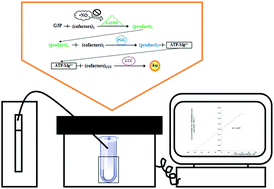
A novel optimized coupled bioluminescent assay for nitrogen monoxide free radical (nitric oxide, ˙NO), an important environmental and physiological molecule, is presented. The method is based on the reaction catalyzed by glyceraldehyde 3-phosphate dehydrogenase (GAPDH), whose product is used as a substrate for phosphoglycerate kinase (PGK), generating adenosine 5′-triphosphate (ATP), which is an essential cofactor for the firefly luciferase bioluminescent reaction. Inhibition of GAPDH by ˙NO hampers the coupled reactions, leading to a depletion of ATP and hence a decrease in the bioluminescent signal. Using diethylamine NONOate (DEA-NONOate) as the ˙NO donor, the assay was optimized through statistical experimental design methodology, namely Plackett–Burman (screening) and Box–Behnken (optimization) designs. The optimized method requires 5 μL of sample per tube in a final reaction volume of 100 μL. It is linear in the range from 10 to 100 nM of ˙NO, with limits of detection and quantitation of 4 and 15 nM, respectively. Limitations in its application to biological samples, together with approaches to solve them, are discussed using human whole saliva and microalgae culture medium as examples.
Recommended Literature
- [1] Excitation dependent bidirectional electron transfer in phthalocyanine-functionalised MoS2 nanosheets? Christopher J. Harrison,Kyle J. Berean,Enrico Della Gaspera,Jian Zhen Ou,Richard B. Kaner,Kourosh Kalantar-zadeh,Torben DaenekeNanoscale, 2016,8, 16276-16283 10.1039/C6NR04326G
- [2] Fe3O4 nanosphere@microporous organic networks: enhanced anode performances in lithium ion batteries through carbonization? Byungho Lim,Jaewon Jin,Jin Yoo,Seung Yong Han,Kyeongyeol Kim,Sungah Kang,Nojin Park,Sang Moon Lee,Hae Jin Kim,Seung Uk SonChem. Commun., 2014,50, 7723-7726 10.1039/C4CC02068E
- [3] Exchanged ligands on the surface of a giant cluster: [(MoO3)176(H2O)63(CH3OH)17Hn](32 – n)– Chem. Commun., 1998, 1501-1502 10.1039/A801804I
- [4] Distribution pattern and allocation of defects in hydrogenated ZnO thin films? Vitaly Gurylev,Chung-Yi Su,Tsong-Pyng PerngPhys. Chem. Chem. Phys., 2016,18, 16033-16038 10.1039/C6CP01768A
- [5] Fe3O4/PEG-SO3H as a heterogeneous and magnetically-recyclable nanocatalyst for the oxidation of sulfides to sulfones or sulfoxides Saeideh Mirfakhraei,Malak Hekmati,Fereshteh Hosseini Eshbala,Hojat VeisiNew J. Chem., 2018,42, 1757-1761 10.1039/C7NJ02513K
- [6] Distinct correlation between (CN2)x units and pores: a low-cost method for predesigned wide range control of micropore size of porous carbon? Xiaotong Feng,Lei Bian,Jie Ma,Lei Zhou,Xiayan Wang,Guangsheng Guo,Qiaosheng PuChem. Commun., 2019,55, 3963-3966 10.1039/C9CC01213C
- [7] Fe/Fe3C@C nanoparticles encapsulated in N-doped graphene–CNTs framework as an efficient bifunctional oxygen electrocatalyst for robust rechargeable Zn–air batteries? Zhiyan Chen,Nan Wu,Yaobing Wang,Bing Wang,Yingde WangJ. Mater. Chem. A, 2018,6, 516-526 10.1039/C7TA08423D
- [8] Ester-directed orthogonal dual C–H activation and ortho aryl C–H alkenylation via distal weak coordination? Manickam Bakthadoss,Tadiparthi Thirupathi Reddy,Vishal Agarwal,Duddu S. SharadaChem. Commun., 2022,58, 1406-1409 10.1039/D1CC06097J
- [9] Establishing empirical design rules of nucleic acid templates for the synthesis of silver nanoclusters with tunable photoluminescence and functionalities towards targeted bioimaging applications? Jason Y. C. Lim,Yong Yu,Guorui Jin,Kai Li,Yi Lu,Jianping XieNanoscale Adv., 2020,2, 3921-3932 10.1039/D0NA00381F
- [10] Enantiocontrolled construction of sistodiolynne, an unusual polyketide from the wood-decay fungus Sistrema raduloides Chem. Commun., 1997, 767-768 10.1039/A700186J

Journal Name:Analytical Methods
research_products
-

CAS no.: 89640-58-4

![1,2,3,4,5,6-Hexahydro-[2,3]bipyridinyl-6-ol](https://ossimg.kuujia.com/scimg/1271000/1270529-38-8x500.png)


![N-(3-cyanothiolan-3-yl)-2-[(2,2,2-trifluoroethyl)sulfanyl]pyridine-4-carboxamide](https://ossimg.kuujia.com/scimg/1444500/1444113-98-7x500.png)

![2,2-Difluoro-3-[methyl(2-methylbutyl)amino]propanoic acid](https://ossimg.kuujia.com/scimg/2138500/2138166-62-6x500.png)

![2-(1H-indol-3-yl)-N-{[6-(thiophen-2-yl)-[1,2,4]triazolo[4,3-b]pyridazin-3-yl]methyl}acetamide](https://ossimg.kuujia.com/scimg/2034500/2034271-14-0x500.png)