A novel generation of hybrid photochromic vinylidene-naphthofuran silica nanoparticles through fine-tuning of surface chemistry?
Dalton Transactions Pub Date: 2017-06-13 DOI: 10.1039/C7DT01376K
Abstract
Novel photochromic 1-vinylidene-naphtho[2,1-b]furan derivatives (VNF-1 and VNF-2) were successfully anchored onto silica nanoparticles (SiO2 NPs) through direct adsorption (SiO2@VNF-1) and covalent post-grafting (SiO2@VNF-2). SiO2 NPs with different sizes (15 ± 3 and 123 ± 7 nm) and surface chemistry (pHpzc in the range of 5–9) were used, offering a wide range of possibilities to fabricate tailor-made photochromic materials. The characterization of VNF-based SiO2 NPs confirmed the efficient VNF immobilization and the integrity of both organic and inorganic components. The photochromic behavior of these new nanoparticles indicates that silica surface acidity and the type of VNF immobilization strategy (adsorption vs. covalent grafting) were crucial factors for the occurrence of photochromism in the VNF-based SiO2 NPs. Upon UV (λ = 365 nm) or sunlight exposure for 1 min, only the SiO2@VNF-1 nanomaterials prepared by direct VNF adsorption onto SiO2 NPs with pHpzc ≈ 6.0 showed direct and reversible photochromic properties, developing fast (in seconds) and intense salmon and violet coloration, with high values of total color difference (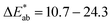 ) and optical densities (ΔOD = 0.14–0.25). In contrast, all nanomaterials prepared by covalent grafting of VNF-2 onto SiO2 NPs (SiO2@VNF-2) did not exhibit photochromism. In the case of the photochromic SiO2@VNF-1 NPs, the decoloration process followed a bi-exponential decay with fast rate constants (k1 = 1.6 × 10?1–1.6 min?1 and k2 = 9.1 × 10?3–1.3 × 10?1 min?1), which were responsible for the loss of coloration in less than 10 min. Furthermore, they presented very good resistance to fatigue, showing reversibility between the colored/uncolored states without significant loss of their performance for at least 8 successive UV/dark cycles.

Recommended Literature
- [1] Evolutionary approaches in protein engineering towards biomaterial construction Brindha J.,Balamurali M. M.,Kaushik ChandaRSC Adv., 2019,9, 34720-34734 10.1039/C9RA06807D
- [2] Establishing empirical design rules of nucleic acid templates for the synthesis of silver nanoclusters with tunable photoluminescence and functionalities towards targeted bioimaging applications? Jason Y. C. Lim,Yong Yu,Guorui Jin,Kai Li,Yi Lu,Jianping XieNanoscale Adv., 2020,2, 3921-3932 10.1039/D0NA00381F
- [3] Distinct impact of glycation towards the aggregation and toxicity of murine and human amyloid-β? Eunju Nam,Jiyeon Han,Sunhee Choi,Mi Hee LimChem. Commun., 2021,57, 7637-7640 10.1039/D1CC02695J
- [4] Fatty acid positional distribution in colostrum and mature milk of women living in Inner Mongolia, North Jiangsu and Guangxi of China? Long Deng,Qian Zou,Biao Liu,Wenhui Ye,Chengfei Zhuo,Li Chen,Ze-Yuan Deng,Ya-Wei Fan,Jing LiFood Funct., 2018,9, 4234-4245 10.1039/C8FO00787J
- [5] Evolutionary de novo design of phenothiazine derivatives for dye-sensitized solar cells? Vishwesh Venkatraman,Marco Foscato,Vidar R. Jensen,Bj?rn K?re AlsbergJ. Mater. Chem. A, 2015,3, 9851-9860 10.1039/C5TA00625B
- [6] Elusive 2-aminofuran Diels–Alder substrates for a straightforward synthesis of polysubstituted anilines? Ana G. Neo,Ana Bornadiego,Jesús Díaz,Stefano Marcaccini,Carlos F. MarcosOrg. Biomol. Chem., 2013,11, 6546-6555 10.1039/C3OB41411F
- [7] Excited state dynamics of symmetric and asymmetric Cr3(dpa)4Cl2 measured using femtosecond transient absorption spectroscopy? Chao-Han Cheng,Wen-Zhen Wang,Shie-Ming Peng,I-Chia ChenPhys. Chem. Chem. Phys., 2017,19, 25471-25477 10.1039/C7CP03968A
- [8] Exchanged ligands on the surface of a giant cluster: [(MoO3)176(H2O)63(CH3OH)17Hn](32 – n)– Chem. Commun., 1998, 1501-1502 10.1039/A801804I
- [9] Fe3O4/FeS2 heterostructures enable efficient oxygen evolution reaction? Xingqun Zheng,Lele Song,Xin Feng,Li Li,Zidong WeiJ. Mater. Chem. A, 2020,8, 14145-14151 10.1039/C9TA13775K
- [10] Evidence of CO2 molecule acting as an electron acceptor on a nanoporous metal–organic-framework MIL-53 or Cr3+(OH)(O2C–C6H4–CO2)? Alexandre Vimont,Arnaud Travert,Philippe Bazin,Jean-Claude Lavalley,Marco Daturi,Christian Serre,Gérard Férey,Sandrine Bourrelly,Philip L. LlewellynChem. Commun., 2007, 3291-3293 10.1039/B703468G

Journal Name:Dalton Transactions
research_products
-

CAS no.: 89640-58-4


![N-(3-cyanothiolan-3-yl)-2-[(2,2,2-trifluoroethyl)sulfanyl]pyridine-4-carboxamide](https://ossimg.kuujia.com/scimg/1444500/1444113-98-7x500.png)

![1,2,3,4,5,6-Hexahydro-[2,3]bipyridinyl-6-ol](https://ossimg.kuujia.com/scimg/1271000/1270529-38-8x500.png)

![2,2-Difluoro-3-[methyl(2-methylbutyl)amino]propanoic acid](https://ossimg.kuujia.com/scimg/2138500/2138166-62-6x500.png)

![2-(1H-indol-3-yl)-N-{[6-(thiophen-2-yl)-[1,2,4]triazolo[4,3-b]pyridazin-3-yl]methyl}acetamide](https://ossimg.kuujia.com/scimg/2034500/2034271-14-0x500.png)