A novel antimicrobial technology to enhance food safety and quality of leafy vegetables using engineered water nanostructures?
Environmental Science: Nano Pub Date: 2020-12-23 DOI: 10.1039/D0EN00814A
Abstract
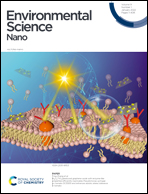
Here, we report a novel, “dry”, nano-aerosol-based, antimicrobial technology using engineered water nanostructures (EWNSs) for leafy vegetable disinfection. These EWNS based nano-sanitizers are synthesized using a combined process of electrospray and ionization of aqueous solutions of generally recognized as safe active ingredients (AIs). A novel application of the EWNS to vegetable surfaces was carried out in this study. The EWNS-based nano-sanitizers were synthesized using an AI cocktail (10% hydrogen peroxide, 1% citric acid, 0.1% lysozyme and 0.0025% nisin), and their efficacy against foodborne pathogen surrogates and plant pathogens was assessed using a leafy vegetable model, namely spinach (Spinacia oleracea). The EWNSs were directed onto a coupon cut from spinach leaves, which were inoculated with microorganisms relevant to food safety, such as E. coli. It was shown that a 2 min exposure to EWNS-based nano-sanitizers significantly (P < 0.05) reduced the cell populations of Escherichia coli, Listeria innocua, and Pseudomonas fluorescens on spinach by 3.5, 1.2 and 2.6 log, respectively. The EWNS also reduced Penicillium italicum spores by 1 log in 15 minutes and bacteriophage MS2 by 1.4 log in 5 minutes. More importantly, the estimated delivered dose of AIs using the EWNS approach was minuscule (258 pg cm?2 for a 15-minute exposure). No significant difference (P > 0.05) in color or surface pH of spinach was found after 15 minutes of exposure. In summary, EWNS based nano-sanitizers are highly effective against foodborne pathogen surrogates and plant pathogens using only nanograms of nature-derived active ingredients and without an impact on produce quality.

Recommended Literature
- [1] Essential effect of the electrolyte on the mechanical and chemical degradation of LiNi0.8Co0.15Al0.05O2 cathodes upon long-term cycling?? Xiaoming Liu,Zachary D. Hood,Wangda Li,Donovan N. Leonard,Arumugam Manthiram,Miaofang ChiJ. Mater. Chem. A, 2021,9, 2111-2119 10.1039/D0TA07814J
- [2] Emergence of microfluidic wearable technologies Joo Chuan Yeo,KenryLab Chip, 2016,16, 4082-4090 10.1039/C6LC00926C
- [3] Exceptionally high temperature spin crossover in amide-functionalised 2,6-bis(pyrazol-1-yl)pyridine iron(ii) complex revealed by variable temperature Raman spectroscopy and single crystal X-ray diffraction? Max Attwood,Hiroki Akutsu,Lee Martin,Toby J. Blundell,Pierre Le Maguere,Scott S. TurnerDalton Trans., 2021,50, 11843-11851 10.1039/D1DT01743H
- [4] Exchanged ligands on the surface of a giant cluster: [(MoO3)176(H2O)63(CH3OH)17Hn](32 – n)– Chem. Commun., 1998, 1501-1502 10.1039/A801804I
- [5] Excess electrons in lithium–ethylamine solutions—density, electrical conductivity and EPR studies Phys. Chem. Chem. Phys., 1999,1, 3561-3565 10.1039/A900683D
- [6] Fatty acid positional distribution in colostrum and mature milk of women living in Inner Mongolia, North Jiangsu and Guangxi of China? Long Deng,Qian Zou,Biao Liu,Wenhui Ye,Chengfei Zhuo,Li Chen,Ze-Yuan Deng,Ya-Wei Fan,Jing LiFood Funct., 2018,9, 4234-4245 10.1039/C8FO00787J
- [7] Fe(iii)-mediated isomerization of α,α-diarylallylic alcohols to ketones via radical 1,2-aryl migration? Ziyang Deng,Changwei Chen,Sunliang CuiRSC Adv., 2016,6, 93753-93755 10.1039/C6RA20007A
- [8] Fe(ii)-Assisted one-pot synthesis of ultra-small core–shell Au–Pt nanoparticles as superior catalysts towards the HER and ORR? Yi Cao,Yujiao Xiahou,Lixiang Xing,Xiang Zhang,Hong Li,ChenShou Wu,Haibing XiaNanoscale, 2020,12, 20456-20466 10.1039/D0NR04995F
- [9] Elusive 2-aminofuran Diels–Alder substrates for a straightforward synthesis of polysubstituted anilines? Ana G. Neo,Ana Bornadiego,Jesús Díaz,Stefano Marcaccini,Carlos F. MarcosOrg. Biomol. Chem., 2013,11, 6546-6555 10.1039/C3OB41411F
- [10] Evidence of CO2 molecule acting as an electron acceptor on a nanoporous metal–organic-framework MIL-53 or Cr3+(OH)(O2C–C6H4–CO2)? Alexandre Vimont,Arnaud Travert,Philippe Bazin,Jean-Claude Lavalley,Marco Daturi,Christian Serre,Gérard Férey,Sandrine Bourrelly,Philip L. LlewellynChem. Commun., 2007, 3291-3293 10.1039/B703468G
Journal Name:Environmental Science: Nano
research_products
-

CAS no.: 89640-58-4


![N-(3-cyanothiolan-3-yl)-2-[(2,2,2-trifluoroethyl)sulfanyl]pyridine-4-carboxamide](https://ossimg.kuujia.com/scimg/1444500/1444113-98-7x500.png)

![1,2,3,4,5,6-Hexahydro-[2,3]bipyridinyl-6-ol](https://ossimg.kuujia.com/scimg/1271000/1270529-38-8x500.png)

![2,2-Difluoro-3-[methyl(2-methylbutyl)amino]propanoic acid](https://ossimg.kuujia.com/scimg/2138500/2138166-62-6x500.png)

![2-(1H-indol-3-yl)-N-{[6-(thiophen-2-yl)-[1,2,4]triazolo[4,3-b]pyridazin-3-yl]methyl}acetamide](https://ossimg.kuujia.com/scimg/2034500/2034271-14-0x500.png)