Intermolecular interactions in hydrates of 4-methylpiperidine and 4-chloropiperidine – a structural and computational study?
CrystEngComm Pub Date: 2020-12-18 DOI: 10.1039/D0CE01585G
Abstract
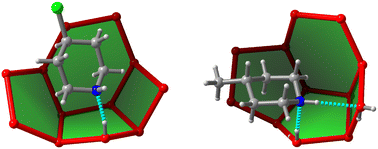
The structures and interactions in four new hydrates of substituted piperidines have been studied using X-ray crystallography and quantum chemistry. The piperidine ring substitution leads to a significant reduction in the number of hydrates compared with the parent amine, with 4-methylpiperidine yielding a hemihydrate and a trihydrate; 4-chloropiperidine a monohydrate and a trihydrate, (where the architecture is similar to 4-methylpiperidine trihydrate). Despite many attempts, it did not prove possible to crystallize hydrates with higher molar amine?:?water ratios. Therefore, trihydrates are probably the most hydrated crystals to be obtained at ambient pressure for both amines. Both trihydrates create identical water layers of the L4(6)5(7)6(8) type and the main structural difference is the arrangement of hydrogen bonds between water layers and amines. Despite this, both trihydrates have the same melting temperature (263 K) and as supported by lattice energy calculations. Chlorine?chlorine contacts have no significant impact on the stabilization of the 4-chloropiperidine monohydrate or the 4-chloropiperidine trihydrate. Periodic DFT-D3 calculations show that the energies of the water layers are identical in both cases, and the summed hydrogen bond energies (although arranged differently) are similar. Moreover, in the case of trihydrates, which have a 2-D topology of water?water interactions, it is possible to perform DFT calculations for separate layers and to determine the contribution of those interaction energies to the cohesive energy of the whole crystals.
Recommended Literature
- [1] Enantio- & chemo-selective preparation of enantiomerically enriched aliphatic nitro alcohols using Candida parapsilosis ATCC 7330 Sowmyalakshmi VenkataramanRSC Adv., 2015,5, 73807-73813 10.1039/C5RA13593A
- [2] Exciplex emission from the mixed dimer of naphthalene and 2-cyanonaphthalene in a supersonic jet Aloke Das,K. K. Mahato,Chayan K. Nandi,Tapas Chakraborty,Shridhar R. Gadre,Nikhil A. GokhalePhys. Chem. Chem. Phys., 2002,4, 2162-2168 10.1039/B200124C
- [3] Evolution of hierarchical porous structures in supramolecular guest–host hydrogels? Christopher B. Rodell,Christopher B. Highley,Minna H. Chen,Neville N. Dusaj,Chao Wang,Lin Han,Jason A. BurdickSoft Matter, 2016,12, 7839-7847 10.1039/C6SM01395C
- [4] Evolution study of photo-synthesized gold nanoparticles by spectral deconvolution model: a quantitative approach Chung-Sung Yang,Mong-Shian Shih,Fang-Yi ChangNew J. Chem., 2006,30, 729-735 10.1039/B516465F
- [5] EWOD-driven droplet microfluidic device integrated with optoelectronic tweezers as an automated platform for cellular isolation and analysis? Gaurav J. Shah,Eric P.-Y. Chiou,Ming C. Wu,Chang-Jin “CJ” KimLab Chip, 2009,9, 1732-1739 10.1039/B821508A
- [6] Exchanged ligands on the surface of a giant cluster: [(MoO3)176(H2O)63(CH3OH)17Hn](32 – n)– Chem. Commun., 1998, 1501-1502 10.1039/A801804I
- [7] Enabling stable MnO2 matrix for aqueous zinc-ion battery cathodes? Yiding Jiao,Liqun Kang,Jasper Berry-Gair,Kit McColl,Jianwei Li,Haobo Dong,Hao Jiang,Ryan Wang,Furio Corà,Dan J. L. Brett,Ivan P. ParkinJ. Mater. Chem. A, 2020,8, 22075-22082 10.1039/D0TA08638J
- [8] Examination of the hydrogen-bonding networks in small water clusters (n = 2–5, 13, 17) using absolutely localized molecular orbital energy decomposition analysis? Erika A. Cobar,Paul R. Horn,Robert G. Bergman,Martin Head-GordonPhys. Chem. Chem. Phys., 2012,14, 15328-15339 10.1039/C2CP42522J
- [9] Excitation dependent bidirectional electron transfer in phthalocyanine-functionalised MoS2 nanosheets? Christopher J. Harrison,Kyle J. Berean,Enrico Della Gaspera,Jian Zhen Ou,Richard B. Kaner,Kourosh Kalantar-zadeh,Torben DaenekeNanoscale, 2016,8, 16276-16283 10.1039/C6NR04326G
- [10] Fe/S-Catalyzed synthesis of 2-benzoylbenzoxazoles and 2-quinolylbenzoxazoles via redox condensation of o-nitrophenols with acetophenones and methylquinolines? Thi Thu Tram Nguyen,Thanh Binh NguyenOrg. Biomol. Chem., 2021,19, 6015-6020 10.1039/D1OB00976A

Journal Name:CrystEngComm
research_products
-

CAS no.: 89640-58-4


![N-(3-cyanothiolan-3-yl)-2-[(2,2,2-trifluoroethyl)sulfanyl]pyridine-4-carboxamide](https://ossimg.kuujia.com/scimg/1444500/1444113-98-7x500.png)

![1,2,3,4,5,6-Hexahydro-[2,3]bipyridinyl-6-ol](https://ossimg.kuujia.com/scimg/1271000/1270529-38-8x500.png)

![2,2-Difluoro-3-[methyl(2-methylbutyl)amino]propanoic acid](https://ossimg.kuujia.com/scimg/2138500/2138166-62-6x500.png)

![2-(1H-indol-3-yl)-N-{[6-(thiophen-2-yl)-[1,2,4]triazolo[4,3-b]pyridazin-3-yl]methyl}acetamide](https://ossimg.kuujia.com/scimg/2034500/2034271-14-0x500.png)