Emerging investigators series: highly effective adsorption of organic aromatic molecules from aqueous environments by electronically sorted single-walled carbon nanotubes?
Environmental Science: Water Research & Technology Pub Date: 2017-01-05 DOI: 10.1039/C6EW00284F
Abstract
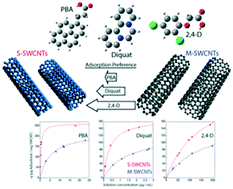
The use of electronically sorted (i.e. semiconducting or metallic) single-walled carbon nanotubes (SWCNTs) for the removal of organic compounds from aqueous environments is investigated. Chromatography techniques are used to separate the semiconducting type from the metallic type. Spectroscopy (including UV-visible) is employed to measure the uptake of 1-pyrenebutyric acid, diquat dibromide, and 2,4-dichlorophenoxyacetic acid onto the sorted SWCNTs. Kinetic and equilibrium analysis show that the semiconducting type is capable of adsorbing up to 70.6% more adsorbate compared to the metallic type. This is likely attributed to the favorability of these compounds interacting with the semiconducting type due to a lack of electron density around this type of SWCNT. Moreover, a comparison of the material separated in-house by chromatography to those purchased from a commercial source shows that the in-house material is capable of adsorbing 26.5 to 60% more adsorbate versus the commercial material in which the SWCNTs were separated using density gradient ultracentrifugation methods. This demonstrates that chromatography techniques potentially yield a more effective separation of the semiconducting and metallic SWCNTs. Such opportunities can be influential in the development of new adsorbent systems towards removal of targeted compounds from aqueous environments.
Recommended Literature
- [1] Estimation of activation energy for electroporation and pore growth rate in liquid crystalline and gel phases of lipid bilayers using molecular dynamics simulations? Amit Kumar Majhi,Subbarao Kanchi,V. Venkataraman,K. G. Ayappa,Prabal K. MaitiSoft Matter, 2015,11, 8632-8640 10.1039/C5SM02029H
- [2] Enantiocontrolled construction of sistodiolynne, an unusual polyketide from the wood-decay fungus Sistrema raduloides Chem. Commun., 1997, 767-768 10.1039/A700186J
- [3] Enabling high-throughput single-animal gene-expression studies with molecular and micro-scale technologies Jason WanLab Chip, 2020,20, 4528-4538 10.1039/D0LC00881H
- [4] Fe(ii)-Assisted one-pot synthesis of ultra-small core–shell Au–Pt nanoparticles as superior catalysts towards the HER and ORR? Yi Cao,Yujiao Xiahou,Lixiang Xing,Xiang Zhang,Hong Li,ChenShou Wu,Haibing XiaNanoscale, 2020,12, 20456-20466 10.1039/D0NR04995F
- [5] Evolution of dealloying induced strain in nanoporous gold crystals? Ross Harder,David C. Dunand,Ian McNultyNanoscale, 2017,9, 5686-5693 10.1039/C6NR09635B
- [6] Fe3O4/FeS2 heterostructures enable efficient oxygen evolution reaction? Xingqun Zheng,Lele Song,Xin Feng,Li Li,Zidong WeiJ. Mater. Chem. A, 2020,8, 14145-14151 10.1039/C9TA13775K
- [7] Excellent mechanical performance and enhanced dielectric properties of OBC/SiO2 elastomeric nanocomposites: effect of dispersion of the SiO2 nanoparticles? Xing Zhao,Lu Bai,Rui-Ying Bao,Zheng-Ying Liu,Ming-Bo Yang,Wei YangRSC Adv., 2017,7, 46297-46305 10.1039/C7RA08074C
- [8] Dissociation of large gaseous serine clusters produces abundant protonated serine octamer Jacob S. Jordan,Evan R. WilliamsAnalyst, 2021,146, 2617-2625 10.1039/D1AN00273B
- [9] Fatty acid eutectic mixtures and derivatives from non-edible animal fat as phase change materials? Pau Gallart-Sirvent,Marc Martín,Gemma Villorbina,Mercè Balcells,Aran Solé,Luisa F. Cabeza,Ramon Canela-GarayoaRSC Adv., 2017,7, 24133-24139 10.1039/C7RA03845C
- [10] Exceptional activity of sub-nm Pt clusters on CdS for photocatalytic hydrogen production: a combined experimental and first-principles study? Qiyuan Wu,Shangmin Xiong,Peichuan Shen,Shen Zhao,Alexander OrlovCatal. Sci. Technol., 2015,5, 2059-2064 10.1039/C4CY01563K
Journal Name:Environmental Science: Water Research & Technology
research_products
-

CAS no.: 89640-58-4


![N-(3-cyanothiolan-3-yl)-2-[(2,2,2-trifluoroethyl)sulfanyl]pyridine-4-carboxamide](https://ossimg.kuujia.com/scimg/1444500/1444113-98-7x500.png)

![1,2,3,4,5,6-Hexahydro-[2,3]bipyridinyl-6-ol](https://ossimg.kuujia.com/scimg/1271000/1270529-38-8x500.png)

![2,2-Difluoro-3-[methyl(2-methylbutyl)amino]propanoic acid](https://ossimg.kuujia.com/scimg/2138500/2138166-62-6x500.png)

![2-(1H-indol-3-yl)-N-{[6-(thiophen-2-yl)-[1,2,4]triazolo[4,3-b]pyridazin-3-yl]methyl}acetamide](https://ossimg.kuujia.com/scimg/2034500/2034271-14-0x500.png)