Extended tetrathiafulvalenes with polycyclic aromatic cores
Journal of Materials Chemistry C Pub Date: 2019-02-16 DOI: 10.1039/C9TC00120D
Abstract
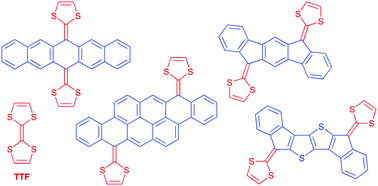
Redox-active organic molecules have found interest in various areas of materials chemistry, from organic conductors, electrochromic materials, sensors, to constituents of molecular machines. Tetrathiafulvalene (TTF) has been one of the most exploited molecules for advanced materials owing to its two reversible one-electron oxidations. Polycyclic aromatic hydrocarbons (PAHs) are another class of organic molecules that has played a unique role in materials chemistry on account of their electronic properties. By combining TTFs and PAHs new electronic properties emerge. Indeed, an extension of the TTF by a large π-conjugated spacer between the two dithiole rings has significant implications for the redox properties, the optical properties of the various redox states, and the ability to form mixed valence and π-dimer associates upon oxidation; i.e., neutral·radical cation (nc) and radical cation·radical cation (cc) complexes. Here we review the properties of such extended and “super-extended” TTFs, divided into two classes based on the nature of the spacer: (i) one- and two-dimensional PAH spacers comprised of fused benzene rings, (ii) indacene- and benzo- or thieno-fused indacene spacers where the dithiafulvene units are placed at five-membered rings in the spacer. The two classes will be limited to structures where the exocyclic fulvene carbon atom of each dithiafulvene unit is part of a five- or six-membered all-carbon ring (while heterocyclic rings may be fused to this ring). Digital simulation of the experimental cyclic voltammograms is key to understanding the complex associations occurring upon oxidation, and the last part of the review gives a small tutorial on this method.
Recommended Literature
- [1] Enabling shape memory and healable effects in a conjugated polymer by incorporating siloxane via dynamic imine bond? Yaling Zhang,Chunhui Dai,Shiwei Zhou,Bin LiuChem. Commun., 2018,54, 10092-10095 10.1039/C8CC05410J
- [2] Examination of ammonia–poly(pyrrole) interactions by piezoelectric and conductivity measurements Analyst, 1991,116, 1125-1130 10.1039/AN9911601125
- [3] Emerging investigator series: heterogeneous reactions of sulfur dioxide on mineral dust nanoparticles: from single component to mixed components? Tao Wang,Yangyang Liu,Yue Deng,Hongbo Fu,Jianmin ChenEnviron. Sci.: Nano, 2018,5, 1821-1833 10.1039/C8EN00376A
- [4] Dissociative electron attachment to HGaF4 Lewis–Br?nsted superacid Marcin Czapla,Jack SimonsPhys. Chem. Chem. Phys., 2018,20, 21739-21745 10.1039/C8CP04007A
- [5] Establishing plasmon contribution to chemical reactions: alkoxyamines as a thermal probe? Olga Guselnikova,Gérard Audran,Jean-Patrick Joly,Andrii Trelin,Evgeny V. Tretyakov,Vaclav Svorcik,Oleksiy Lyutakov,Sylvain R. A. MarqueChem. Sci., 2021,12, 4154-4161 10.1039/D0SC06470J
- [6] Evolution of important glucosinolates in three common Brassica vegetables during their processing into vegetable powder and in vitro gastric digestion Nan Fu,Naphaporn Chiewchan,Xiao Dong ChenFood Funct., 2020,11, 211-220 10.1039/C9FO00811J
- [7] Evidence for the intrinsic nature of band-gap states electrochemically observed on atomically flat TiO2(110) surfaces? Shintaro Takata,Yoshihiro MiuraPhys. Chem. Chem. Phys., 2014,16, 24784-24789 10.1039/C4CP03280B
- [8] Evolutionary approaches in protein engineering towards biomaterial construction Brindha J.,Balamurali M. M.,Kaushik ChandaRSC Adv., 2019,9, 34720-34734 10.1039/C9RA06807D
- [9] Dissolution of cork biopolymers in biocompatible ionic liquids Helga Garcia,Rui Ferreira,Marija Petkovic,Jamie L. Ferguson,Maria C. Leit?o,H. Q. Nimal Gunaratne,Luís Paulo N. RebeloGreen Chem., 2010,12, 367-369 10.1039/B922553F
- [10] Evolution in surface coverage of CH3NH3PbI3?XClXvia heat assisted solvent vapour treatment and their effects on photovoltaic performance of devices Dhirendra K. Chaudhary,Pramendra Kumar,Lokendra KumarRSC Adv., 2016,6, 94731-94738 10.1039/C6RA18729C
Journal Name:Journal of Materials Chemistry C
research_products
-

CAS no.: 89640-58-4


![N-(3-cyanothiolan-3-yl)-2-[(2,2,2-trifluoroethyl)sulfanyl]pyridine-4-carboxamide](https://ossimg.kuujia.com/scimg/1444500/1444113-98-7x500.png)

![1,2,3,4,5,6-Hexahydro-[2,3]bipyridinyl-6-ol](https://ossimg.kuujia.com/scimg/1271000/1270529-38-8x500.png)

![2,2-Difluoro-3-[methyl(2-methylbutyl)amino]propanoic acid](https://ossimg.kuujia.com/scimg/2138500/2138166-62-6x500.png)

![2-(1H-indol-3-yl)-N-{[6-(thiophen-2-yl)-[1,2,4]triazolo[4,3-b]pyridazin-3-yl]methyl}acetamide](https://ossimg.kuujia.com/scimg/2034500/2034271-14-0x500.png)