Emerging applications of porous organic polymers in visible-light photocatalysis
Journal of Materials Chemistry A Pub Date: 2020-03-18 DOI: 10.1039/D0TA00364F
Abstract
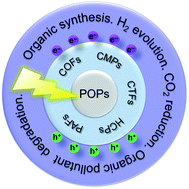
Porous organic polymers (POPs) are emerging porous solids featuring high porosity, low density, diverse composition, facile functionalization, and high thermal/chemical stability. POPs are proven competitive candidates in various applications, such as sorption/separation, energy storage, biomedical applications, optical devices, and catalysis. Photocatalysis enables multifarious transformations of chemicals under mild conditions without enormous energy consumption and contaminant generation. Catalytically active species can be incorporated into POPs by means of covalent bonding or metal–ligand coordination, and the catalytic power of POPs can be fine tuned by modulating the electronic properties of monomers and pore structures of the solids, which make POP-based heterogeneous photocatalysts designable for task-specific applications. The outstanding performance and reusability distinguish POPs from their homogeneous analogues. As a result, their catalytic efficiency can be significantly enhanced and cost would be considerably reduced. In this review, we aim to highlight the recent research of POPs in visible-light-driven photocatalysis, including organic synthesis, hydrogen evolution, carbon dioxide reduction, and degradation of organic pollutants. Technological concerns over the hindrance of preparation, post-processing, performance optimization, cost and energy consumption are also discussed.
Recommended Literature
- [1] Excess electrons in lithium–ethylamine solutions—density, electrical conductivity and EPR studies Phys. Chem. Chem. Phys., 1999,1, 3561-3565 10.1039/A900683D
- [2] Emerging investigator series: bacteriophages as nano engineering tools for quality monitoring and pathogen detection in water and wastewater Fereshteh BayatEnviron. Sci.: Nano, 2021,8, 367-389 10.1039/D0EN00962H
- [3] Dissociative electron attachment to HGaF4 Lewis–Br?nsted superacid Marcin Czapla,Jack SimonsPhys. Chem. Chem. Phys., 2018,20, 21739-21745 10.1039/C8CP04007A
- [4] Estimates of hydride ion stability in condensed systems: energy of formation and solvation in aqueous and polar-organic solvents Craig A. Kelly,David R. RosseinskyPhys. Chem. Chem. Phys., 2001,3, 2086-2090 10.1039/B010092G
- [5] Emulsifier-free, organotellurium-mediated living radical emulsion polymerization (emulsion TERP) of styrene: poly(dimethylaminoethyl methacrylate) macro-TERP agent? Yukiya KitayamaPolym. Chem., 2014,5, 2784-2792 10.1039/C3PY01539D
- [6] Fc microparticles can modulate the physical extent and magnitude of complement activity? David White,Sean R. StowellBiomater. Sci., 2017,5, 463-474 10.1039/C6BM00608F
- [7] Examination of ammonia–poly(pyrrole) interactions by piezoelectric and conductivity measurements Analyst, 1991,116, 1125-1130 10.1039/AN9911601125
- [8] Fe(ii)-Assisted one-pot synthesis of ultra-small core–shell Au–Pt nanoparticles as superior catalysts towards the HER and ORR? Yi Cao,Yujiao Xiahou,Lixiang Xing,Xiang Zhang,Hong Li,ChenShou Wu,Haibing XiaNanoscale, 2020,12, 20456-20466 10.1039/D0NR04995F
- [9] Fe3O4 nanosphere@microporous organic networks: enhanced anode performances in lithium ion batteries through carbonization? Byungho Lim,Jaewon Jin,Jin Yoo,Seung Yong Han,Kyeongyeol Kim,Sungah Kang,Nojin Park,Sang Moon Lee,Hae Jin Kim,Seung Uk SonChem. Commun., 2014,50, 7723-7726 10.1039/C4CC02068E
- [10] Evolved polymerases facilitate selection of fully 2′-OMe-modified aptamers? Zhixia Liu,Tingjian Chen,Floyd E. RomesbergChem. Sci., 2017,8, 8179-8182 10.1039/C7SC03747C

Journal Name:Journal of Materials Chemistry A
research_products
-

CAS no.: 89640-58-4


![N-(3-cyanothiolan-3-yl)-2-[(2,2,2-trifluoroethyl)sulfanyl]pyridine-4-carboxamide](https://ossimg.kuujia.com/scimg/1444500/1444113-98-7x500.png)

![1,2,3,4,5,6-Hexahydro-[2,3]bipyridinyl-6-ol](https://ossimg.kuujia.com/scimg/1271000/1270529-38-8x500.png)

![2,2-Difluoro-3-[methyl(2-methylbutyl)amino]propanoic acid](https://ossimg.kuujia.com/scimg/2138500/2138166-62-6x500.png)

![2-(1H-indol-3-yl)-N-{[6-(thiophen-2-yl)-[1,2,4]triazolo[4,3-b]pyridazin-3-yl]methyl}acetamide](https://ossimg.kuujia.com/scimg/2034500/2034271-14-0x500.png)