Electrochemical corrosion behavior of carbon steel coated by polyaniline copolymers micro/nanostructures
RSC Advances Pub Date: 2014-07-07 DOI: 10.1039/C4RA05826G
Abstract
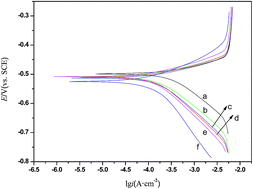
A series of polyaniline (PANI) copolymers micro/nanostructures were prepared in order to investigate the effect of different groups with different hydrophilicities on the corrosion protection behavior of polyanilines. Hydrophilic groups (–SO3H and –COOH) and hydrophobic groups (–CH3 and –C2H5) were introduced into the polyaniline molecular structure by the copolymerization of aniline (ANI) and 3-aminobenzenesulfonic acid, 3-aminobenzoic acid, 3-toluidine and 2-ethyl aniline using ammonium persulfate as an oxidant. The carbon steel coated by the resultant PANI copolymers micro/nanostructures were investigated and compared regarding their electrochemical corrosion in 0.1 M H2SO4. Potentiodynamic polarization curves and electrochemical impedance spectroscopy (EIS) were used. It was found that neither PANI nor PANI copolymers micro/nanostructures provide anodic corrosion protection for carbon steel, but they can effectively restrict the cathodic reaction. Moreover, the ability to restrict the cathodic reaction depends on the surface wettability of the PANI and PANI copolymers micro/nanostructures. The corrosion protection of PANI and PANI copolymers increased along with their water repellency. A well-fitting correlation between the contact angle (θ) of the PANI or PANI copolymers micro/nanostructures coatings and their corrosion protection efficiency (η) was found to be η = 102.22 ? 102.78?exp(?θ/84). The PANI copolymer with the hydrophobic –C2H5 group (PANI-C2H5) showed the largest static water contact angle (CA = 125°) and the most effective protection with an inhibition efficiency of 78.98%.
Recommended Literature
- [1] Exceptional activity of sub-nm Pt clusters on CdS for photocatalytic hydrogen production: a combined experimental and first-principles study? Qiyuan Wu,Shangmin Xiong,Peichuan Shen,Shen Zhao,Alexander OrlovCatal. Sci. Technol., 2015,5, 2059-2064 10.1039/C4CY01563K
- [2] Fatty acid eutectic mixtures and derivatives from non-edible animal fat as phase change materials? Pau Gallart-Sirvent,Marc Martín,Gemma Villorbina,Mercè Balcells,Aran Solé,Luisa F. Cabeza,Ramon Canela-GarayoaRSC Adv., 2017,7, 24133-24139 10.1039/C7RA03845C
- [3] Enabling shape memory and healable effects in a conjugated polymer by incorporating siloxane via dynamic imine bond? Yaling Zhang,Chunhui Dai,Shiwei Zhou,Bin LiuChem. Commun., 2018,54, 10092-10095 10.1039/C8CC05410J
- [4] Enabling high-throughput single-animal gene-expression studies with molecular and micro-scale technologies Jason WanLab Chip, 2020,20, 4528-4538 10.1039/D0LC00881H
- [5] Emerging enantiomeric resolution materials with homochiral nano-fabrications Ji-Ping WeiNanoscale, 2015,7, 11815-11832 10.1039/C5NR03048J
- [6] Evolution of dealloying induced strain in nanoporous gold crystals? Ross Harder,David C. Dunand,Ian McNultyNanoscale, 2017,9, 5686-5693 10.1039/C6NR09635B
- [7] Estimation of activation energy for electroporation and pore growth rate in liquid crystalline and gel phases of lipid bilayers using molecular dynamics simulations? Amit Kumar Majhi,Subbarao Kanchi,V. Venkataraman,K. G. Ayappa,Prabal K. MaitiSoft Matter, 2015,11, 8632-8640 10.1039/C5SM02029H
- [8] Evolution of important glucosinolates in three common Brassica vegetables during their processing into vegetable powder and in vitro gastric digestion Nan Fu,Naphaporn Chiewchan,Xiao Dong ChenFood Funct., 2020,11, 211-220 10.1039/C9FO00811J
- [9] Excellent energy storage performance in NaNbO3-based relaxor antiferroeic ceramics under a low electric field XuxinCheng,XiaomingChen,PengyuanFan 10.1007/s10832-022-00283-w
- [10] Dissociative electron attachment to HGaF4 Lewis–Br?nsted superacid Marcin Czapla,Jack SimonsPhys. Chem. Chem. Phys., 2018,20, 21739-21745 10.1039/C8CP04007A

Journal Name:RSC Advances
research_products
-

CAS no.: 89640-58-4


![N-(3-cyanothiolan-3-yl)-2-[(2,2,2-trifluoroethyl)sulfanyl]pyridine-4-carboxamide](https://ossimg.kuujia.com/scimg/1444500/1444113-98-7x500.png)

![1,2,3,4,5,6-Hexahydro-[2,3]bipyridinyl-6-ol](https://ossimg.kuujia.com/scimg/1271000/1270529-38-8x500.png)

![2,2-Difluoro-3-[methyl(2-methylbutyl)amino]propanoic acid](https://ossimg.kuujia.com/scimg/2138500/2138166-62-6x500.png)

![2-(1H-indol-3-yl)-N-{[6-(thiophen-2-yl)-[1,2,4]triazolo[4,3-b]pyridazin-3-yl]methyl}acetamide](https://ossimg.kuujia.com/scimg/2034500/2034271-14-0x500.png)