Delivery of 5′-triphosphate RNA with endosomolytic nanoparticles potently activates RIG-I to improve cancer immunotherapy?
Biomaterials Science Pub Date: 2018-10-24 DOI: 10.1039/C8BM01064A
Abstract
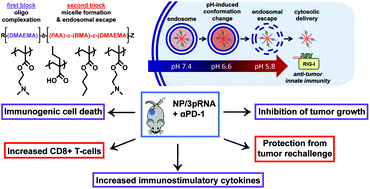
RNA agonists of the retinoic acid gene I (RIG-I) pathway have recently emerged as a promising class of cancer immunotherapeutics, but their efficacy is hindered by drug delivery barriers, including nuclease degradation, poor intracellular uptake, and minimal access to the cytosol where RIG-I is localized. Here, we explore the application of pH-responsive, endosomolytic polymer nanoparticles (NPs) to enhance the cytosolic delivery and immunostimulatory activity of synthetic 5′ triphosphate, short, double-stranded RNA (3pRNA), a ligand for RIG-I. Delivery of 3pRNA with pH-responsive NPs with an active endosomal escape mechanism, but not control carriers lacking endosomolytic activity, significantly increased the activity of 3pRNA in dendritic cells, macrophages, and cancer cell lines. In a CT26 colon cancer model, activation of RIG-I via NP delivery of 3pRNA induced immunogenic cell death, triggered expression of type I interferon and pro-inflammatory cytokines, and increased CD8+ T cell infiltration into the tumor microenvironment. Consequently, intratumoral (IT) delivery of NPs loaded with 3pRNA inhibited CT26 tumor growth and enhanced the therapeutic efficacy of anti-PD-1 immune checkpoint blockade, resulting in a 30% complete response rate and generation of immunological memory that protected against tumor rechallenge. Collectively, these studies demonstrate that pH-responsive NPs can be harnessed to strongly enhance the immunostimulatory activity and therapeutic efficacy of 3pRNA and establish endosomal escape as a critical parameter in the design of carriers for immunotherapeutic targeting of the RIG-I pathway.
Recommended Literature
- [1] Fast synthesis of red Li3BaSrLn3(WO4)8:Eu3+ phosphors for white LEDs under near-UV excitation by a microwave-assisted solid state reaction method and photoluminescence studies Bo Wei,Zhenyu Liu,Chen Xie,Shu Yang,Wentao Tang,Aiwei Gu,Wing-Tak Wong,Ka-Leung WongJ. Mater. Chem. C, 2015,3, 12322-12327 10.1039/C5TC03165F
- [2] Emergence of cationic polyamine dendrimersomes: design, stimuli sensitivity and potential biomedical applications Partha Laskar,Christine DufèsNanoscale Adv., 2021,3, 6007-6026 10.1039/D1NA00536G
- [3] Empowering microfluidics by micro-3D printing and solution-based mineral coating? Hongxia Li,Aikifa Raza,Qiaoyu Ge,Jin-You Lu,TieJun ZhangSoft Matter, 2020,16, 6841-6849 10.1039/D0SM00958J
- [4] Essential effect of the electrolyte on the mechanical and chemical degradation of LiNi0.8Co0.15Al0.05O2 cathodes upon long-term cycling?? Xiaoming Liu,Zachary D. Hood,Wangda Li,Donovan N. Leonard,Arumugam Manthiram,Miaofang ChiJ. Mater. Chem. A, 2021,9, 2111-2119 10.1039/D0TA07814J
- [5] Emergence of microfluidic wearable technologies Joo Chuan Yeo,KenryLab Chip, 2016,16, 4082-4090 10.1039/C6LC00926C
- [6] Excellent lithium ion storage property of porous MnCo2O4 nanorods? Peiyuan Zeng,Xiaoxiao Wang,Ming Ye,Qiuyang Ma,Jianwen Li,Wanwan Wang,Baoyou Geng,Zhen FangRSC Adv., 2016,6, 23074-23084 10.1039/C5RA26176G
- [7] Excellent electrochemical performance of LiFe0.4Mn0.6PO4 microspheres produced using a double carbon coating process? Yong Ping Huang,Tao Tao,Zheng Chen,Wei Han,Ying Wu,Chunjiang Kuang,Shaoxiong Zhou,Ying ChenJ. Mater. Chem. A, 2014,2, 18831-18837 10.1039/C4TA03994G
- [8] Dissociative dynamics of O2 on Ag(110)? Ivor Lon?ari?Phys. Chem. Chem. Phys., 2015,17, 9436-9445 10.1039/C4CP05900J
- [9] Enabling high-throughput single-animal gene-expression studies with molecular and micro-scale technologies Jason WanLab Chip, 2020,20, 4528-4538 10.1039/D0LC00881H
- [10] Fate of single walled carbon nanotubes in wetland ecosystems? Joseph H. Bisesi,Tara Sabo-AttwoodEnviron. Sci.: Nano, 2014,1, 574-583 10.1039/C4EN00063C
Journal Name:Biomaterials Science
research_products
-

CAS no.: 89640-58-4


![N-(3-cyanothiolan-3-yl)-2-[(2,2,2-trifluoroethyl)sulfanyl]pyridine-4-carboxamide](https://ossimg.kuujia.com/scimg/1444500/1444113-98-7x500.png)

![1,2,3,4,5,6-Hexahydro-[2,3]bipyridinyl-6-ol](https://ossimg.kuujia.com/scimg/1271000/1270529-38-8x500.png)

![2,2-Difluoro-3-[methyl(2-methylbutyl)amino]propanoic acid](https://ossimg.kuujia.com/scimg/2138500/2138166-62-6x500.png)

![2-(1H-indol-3-yl)-N-{[6-(thiophen-2-yl)-[1,2,4]triazolo[4,3-b]pyridazin-3-yl]methyl}acetamide](https://ossimg.kuujia.com/scimg/2034500/2034271-14-0x500.png)