Duplex vs. folding: tuning the self-assembly of synthetic recognition-encoded aniline oligomers?
Organic & Biomolecular Chemistry Pub Date: 2021-10-08 DOI: 10.1039/D1OB01882E
Abstract
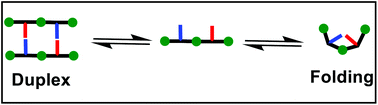
One of the challenges in the realization of synthetic oligomers capable of sequence-selective duplex formation is intramolecular folding interaction between complementary recognition units. To assess whether complementary hetero-oligomers can assemble into high fidelity duplex structures, the competing folding equilibria must be carefully considered. A family of recognition-encoded aniline oligomers were assembled via reductive amination of dianiline linkers and dialdehyde monomers, which were equipped with either a 2-trifluoromethylphenol or a phosphine oxide H-bond recognition unit. To test the possibility of 1,2-folding in mixed sequence oligomers, the self-assembly properties of the homo- and hetero-dimers were characterised by 19F and 1H NMR titration and dilution experiments in toluene and in chloroform. Three different systems were investigated with variations in the steric bulk around the H-bond acceptor unit and the length of the dianiline linker. For two systems, the hetero-dimers folded with intramolecular H-bonding in the monomeric state, reducing stability of the intermolecular duplex by two to three orders of magnitude compared with the corresponding homo-oligomers. However, the use of a long rigid linker as the backbone connecting two monomer units successfully prevents 1,2-folding and leads to the formation of a stable mixed sequence duplex in toluene.
Recommended Literature
- [1] An approach for correlating the structural and electrical properties of Zr4+-modified SrBi4Ti4O15/SBT ceramic Priyambada Nayak,Tanmaya Badapanda,Anil Kumar Singh,Simanchalo PanigrahiRSC Adv., 2017,7, 16319-16331 10.1039/C7RA00366H
- [2] An artificial enzyme cascade amplification strategy for highly sensitive and specific detection of breast cancer-derived exosomes? Huiying Xu,Lu Zheng,Yu Zhou,Bang-Ce YeAnalyst, 2021,146, 5542-5549 10.1039/D1AN01071A
- [3] An arsenic trioxide nanoparticle prodrug (ATONP) potentiates a therapeutic effect on an aggressive hepatocellular carcinoma model via enhancement of intratumoral arsenic accumulation and disturbance of the tumor microenvironment? Xin Fu,Qing-rong Liang,Rong-guang Luo,Yan-shu Li,Xiao-ping Xiao,Lu-lu Yu,Wen-zhe Shan,Guang-qin FanJ. Mater. Chem. B, 2019,7, 3088-3099 10.1039/C9TB00349E
- [4] An amorphous Cu–In–S nanoparticle-based precursor ink with improved atom economy for CuInSe2 solar cells with 10.85% efficiency? Green Chem., 2017,19, 1268-1277 10.1039/C6GC03280J
- [5] An all-solid-state asymmetric device based on a polyaniline hydrogel for a high energy flexible supercapacitor? Hamid Heydari,Mohammad B. GholivandNew J. Chem., 2017,41, 237-244 10.1039/C6NJ02266A
- [6] Alternative mixtures to R-600a. Theoretical assessment and experimental energy evaluation of binary mixtures in a commercial cooler: Mélanges alternatifs au R-600a. évaluation théorique et évaluation énergétique expérimentale de mélanges binaires dans un refroidisseur commercial. DanielCalleja-Anta,DanielSánchez,LauraNebot-Andres,RamónCabello,RodrigoLlopis 10.1016/j.ijrefrig.2023.05.009
- [7] Acetyl group orientation modulates the electronic ground-state asymmetry of the special pair in purple bacterial reaction centers P. K. Wawrzyniak,M. T. P. Beerepoot,H. J. M. de Groot,F. BudaPhys. Chem. Chem. Phys., 2011,13, 10270-10279 10.1039/C1CP20213H
- [8] An amide probe as a selective Al3+ and Fe3+ sensor inside the HeLa and a549 cell lines: Pictet–Spengler reaction for the rapid detection of tryptophan amino acid? Bidyut Kumar Kundu,Rinky Singh,Ritudhwaj Tiwari,Debasis NayakNew J. Chem., 2019,43, 4867-4877 10.1039/C9NJ00138G
- [9] An atom efficient route to N-aryl and N-alkyl pyrrolines by transition metal catalysis? Supaporn Sawadjoon,Joseph S. M. SamecOrg. Biomol. Chem., 2011,9, 2548-2554 10.1039/C0OB00383B
- [10] An Appraisal of pH triggered Bacitracin drug release, through composite hydrogel systems RabailGul,MariamMir,MurtazaNAli 10.1177/08853282231160212

Journal Name:Organic & Biomolecular Chemistry
research_products
-

CAS no.: 89640-58-4

![1,2,3,4,5,6-Hexahydro-[2,3]bipyridinyl-6-ol](https://ossimg.kuujia.com/scimg/1271000/1270529-38-8x500.png)


![N-(3-cyanothiolan-3-yl)-2-[(2,2,2-trifluoroethyl)sulfanyl]pyridine-4-carboxamide](https://ossimg.kuujia.com/scimg/1444500/1444113-98-7x500.png)

![2,2-Difluoro-3-[methyl(2-methylbutyl)amino]propanoic acid](https://ossimg.kuujia.com/scimg/2138500/2138166-62-6x500.png)

![2-(1H-indol-3-yl)-N-{[6-(thiophen-2-yl)-[1,2,4]triazolo[4,3-b]pyridazin-3-yl]methyl}acetamide](https://ossimg.kuujia.com/scimg/2034500/2034271-14-0x500.png)