Cytotoxicity of TiO2 nanoparticles toward Escherichia coli in an aquatic environment: effects of nanoparticle structural oxygen deficiency and aqueous salinity?
Environmental Science: Nano Pub Date: 2017-04-06 DOI: 10.1039/C6EN00664G
Abstract
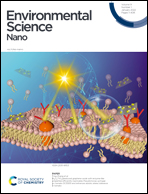
Although the cytotoxicity of TiO2 NPs has been examined on various biological species, it remains a mystery how the NPs' crystal structural deficiency (i.e., oxygen vacancies and other structural defects) may affect their reactivity toward living organisms. Here we present a model study using precursor TiO2 NPs (i.e., anatase, rutile and P25) and their structurally defective derivatives that contain relatively large amounts of oxygen vacancies (namely TiO2-OD NPs) to investigate the NPs' cytotoxicity toward E. coli cells, considering salinity as an important estuarine environmental factor. The results showed that the presence of oxygen vacancies in the TiO2 NPs had a direct effect on the NPs' photocatalytic reactivity and generation of surface reactive oxygen species (ROS), leading to significantly increased cytotoxicity of the TiO2-OD NPs in comparison to their precursor NPs under UVA irradiation, especially for anatase and P25. Further, it was revealed that the aqueous salinity played an important role in affecting the interactions of the E. coli cells with the TiO2/TiO2-OD NPs. At elevated salinities, the concentrations of surface ROS were consistently lowered for the tested NPs, but the antioxidant gene expressions in the tested cells were also dramatically suppressed, and thus, the overall demonstrated cytotoxicity of the TiO2 and TiO2-OD NPs were increased at higher salinities. This finding was verified by the results of cytotoxicity tests for the TiO2 and TiO2-OD NPs using natural estuarine water. As such, our work has provided new insight into the impact of engineered nanoparticles on the microbial ecology in brackish waters.

Recommended Literature
- [1] Emulsifier-free, organotellurium-mediated living radical emulsion polymerization (emulsion TERP) of styrene: poly(dimethylaminoethyl methacrylate) macro-TERP agent? Yukiya KitayamaPolym. Chem., 2014,5, 2784-2792 10.1039/C3PY01539D
- [2] Dissociation of large gaseous serine clusters produces abundant protonated serine octamer Jacob S. Jordan,Evan R. WilliamsAnalyst, 2021,146, 2617-2625 10.1039/D1AN00273B
- [3] Emerging enantiomeric resolution materials with homochiral nano-fabrications Ji-Ping WeiNanoscale, 2015,7, 11815-11832 10.1039/C5NR03048J
- [4] Excellent energy storage performance in NaNbO3-based relaxor antiferroeic ceramics under a low electric field XuxinCheng,XiaomingChen,PengyuanFan 10.1007/s10832-022-00283-w
- [5] Exceptional activity of sub-nm Pt clusters on CdS for photocatalytic hydrogen production: a combined experimental and first-principles study? Qiyuan Wu,Shangmin Xiong,Peichuan Shen,Shen Zhao,Alexander OrlovCatal. Sci. Technol., 2015,5, 2059-2064 10.1039/C4CY01563K
- [6] Enabling high-throughput single-animal gene-expression studies with molecular and micro-scale technologies Jason WanLab Chip, 2020,20, 4528-4538 10.1039/D0LC00881H
- [7] Fe3O4/FeS2 heterostructures enable efficient oxygen evolution reaction? Xingqun Zheng,Lele Song,Xin Feng,Li Li,Zidong WeiJ. Mater. Chem. A, 2020,8, 14145-14151 10.1039/C9TA13775K
- [8] Distinct impact of glycation towards the aggregation and toxicity of murine and human amyloid-β? Eunju Nam,Jiyeon Han,Sunhee Choi,Mi Hee LimChem. Commun., 2021,57, 7637-7640 10.1039/D1CC02695J
- [9] Excellent mechanical performance and enhanced dielectric properties of OBC/SiO2 elastomeric nanocomposites: effect of dispersion of the SiO2 nanoparticles? Xing Zhao,Lu Bai,Rui-Ying Bao,Zheng-Ying Liu,Ming-Bo Yang,Wei YangRSC Adv., 2017,7, 46297-46305 10.1039/C7RA08074C
- [10] Evolution of important glucosinolates in three common Brassica vegetables during their processing into vegetable powder and in vitro gastric digestion Nan Fu,Naphaporn Chiewchan,Xiao Dong ChenFood Funct., 2020,11, 211-220 10.1039/C9FO00811J
Journal Name:Environmental Science: Nano
research_products
-

CAS no.: 89640-58-4


![N-(3-cyanothiolan-3-yl)-2-[(2,2,2-trifluoroethyl)sulfanyl]pyridine-4-carboxamide](https://ossimg.kuujia.com/scimg/1444500/1444113-98-7x500.png)

![1,2,3,4,5,6-Hexahydro-[2,3]bipyridinyl-6-ol](https://ossimg.kuujia.com/scimg/1271000/1270529-38-8x500.png)

![2,2-Difluoro-3-[methyl(2-methylbutyl)amino]propanoic acid](https://ossimg.kuujia.com/scimg/2138500/2138166-62-6x500.png)

![2-(1H-indol-3-yl)-N-{[6-(thiophen-2-yl)-[1,2,4]triazolo[4,3-b]pyridazin-3-yl]methyl}acetamide](https://ossimg.kuujia.com/scimg/2034500/2034271-14-0x500.png)