Effect of ligand binding on a protein with a complex folding landscape?
Physical Chemistry Chemical Physics Pub Date: 2017-06-26 DOI: 10.1039/C7CP03327C
Abstract
Ligand binding to a protein can stabilize it significantly against unfolding. The variation of the folding free energy, ΔΔG0, due to ligand binding can be derived from a simple reaction scheme involving exclusive binding to the native state. One obtains the following expression: 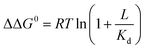 , where Kd is the ligand dissociation constant and L is its concentration, R is the universal gas constant and T is the temperature. This expression has been shown to correctly describe experimental results on multiple proteins. In the current work we studied the effect of ligand binding on the stability of the multi-domain protein adenylate kinase from E. coli (AKE). Unfolding experiments were conducted using single-molecule FRET spectroscopy, which allowed us to directly obtain the fraction of unfolded protein in a model-free way from FRET efficiency histograms. Surprisingly, it was found that the effect of two inhibitors (Ap5A and AMPPNP) and a substrate (AMP) on the stability of AKE was much smaller than expected based on Kd values obtained independently using microscale thermophoresis. To shed light on this issue, we measured the Kd for Ap5A over a range of chemical denaturant concentrations where the protein is still folded. It was found that Kd increases dramatically over this range, likely due to the population of folding intermediates, whose binding to the ligand is much weaker than that of the native state. We propose that binding to folding intermediates may dominate the effect of ligands on the stability of multi-domain proteins, and could therefore have a strong impact on protein homeostasis in vivo.

Recommended Literature
- [1] Exceptionally high temperature spin crossover in amide-functionalised 2,6-bis(pyrazol-1-yl)pyridine iron(ii) complex revealed by variable temperature Raman spectroscopy and single crystal X-ray diffraction? Max Attwood,Hiroki Akutsu,Lee Martin,Toby J. Blundell,Pierre Le Maguere,Scott S. TurnerDalton Trans., 2021,50, 11843-11851 10.1039/D1DT01743H
- [2] Estimating and correcting interference fringes in infrared spectra in infrared hyperspectral imaging Ghazal Azarfar,Ebrahim Aboualizadeh,Nicholas M. Walter,Simona Ratti,Camilla Olivieri,Alessandra Norici,Michael Nasse,Achim Kohler,Mario GiordanoAnalyst, 2018,143, 4674-4683 10.1039/C8AN00093J
- [3] Emergence of microfluidic wearable technologies Joo Chuan Yeo,KenryLab Chip, 2016,16, 4082-4090 10.1039/C6LC00926C
- [4] Establishing the accuracy of position-specific carbon isotope analysis of propane by GC-pyrolysis-GC-IRMS ChangjieLiu,PengLiu,XiaofengWang,XiaoqiangLi,JuskeHorita 10.1002/rcm.9494
- [5] Evolution of shape, size, and areal density of a single plane of Si nanocrystals embedded in SiO2 matrix studied by atom probe tomography Bin Han,Yasuo Shimizu,Gabriele Seguini,Celia Castro,Gérard Ben Assayag,Koji Inoue,Yasuyoshi Nagai,Sylvie Schamm-Chardon,Michele PeregoRSC Adv., 2016,6, 3617-3622 10.1039/C5RA26710B
- [6] Exchanged ligands on the surface of a giant cluster: [(MoO3)176(H2O)63(CH3OH)17Hn](32 – n)– Chem. Commun., 1998, 1501-1502 10.1039/A801804I
- [7] Evidence of CO2 molecule acting as an electron acceptor on a nanoporous metal–organic-framework MIL-53 or Cr3+(OH)(O2C–C6H4–CO2)? Alexandre Vimont,Arnaud Travert,Philippe Bazin,Jean-Claude Lavalley,Marco Daturi,Christian Serre,Gérard Férey,Sandrine Bourrelly,Philip L. LlewellynChem. Commun., 2007, 3291-3293 10.1039/B703468G
- [8] Fe3O4/FeS2 heterostructures enable efficient oxygen evolution reaction? Xingqun Zheng,Lele Song,Xin Feng,Li Li,Zidong WeiJ. Mater. Chem. A, 2020,8, 14145-14151 10.1039/C9TA13775K
- [9] Dissociation of large gaseous serine clusters produces abundant protonated serine octamer Jacob S. Jordan,Evan R. WilliamsAnalyst, 2021,146, 2617-2625 10.1039/D1AN00273B
- [10] Evolutionary de novo design of phenothiazine derivatives for dye-sensitized solar cells? Vishwesh Venkatraman,Marco Foscato,Vidar R. Jensen,Bj?rn K?re AlsbergJ. Mater. Chem. A, 2015,3, 9851-9860 10.1039/C5TA00625B

Journal Name:Physical Chemistry Chemical Physics
research_products
-

CAS no.: 89640-58-4

![1,2,3,4,5,6-Hexahydro-[2,3]bipyridinyl-6-ol](https://ossimg.kuujia.com/scimg/1271000/1270529-38-8x500.png)


![N-(3-cyanothiolan-3-yl)-2-[(2,2,2-trifluoroethyl)sulfanyl]pyridine-4-carboxamide](https://ossimg.kuujia.com/scimg/1444500/1444113-98-7x500.png)

![2,2-Difluoro-3-[methyl(2-methylbutyl)amino]propanoic acid](https://ossimg.kuujia.com/scimg/2138500/2138166-62-6x500.png)

![2-(1H-indol-3-yl)-N-{[6-(thiophen-2-yl)-[1,2,4]triazolo[4,3-b]pyridazin-3-yl]methyl}acetamide](https://ossimg.kuujia.com/scimg/2034500/2034271-14-0x500.png)