Design, synthesis and antifungal activity of carboxylic acid amide fungicides: part 2: substituted 1-phenyl-2-phenoxyethylamino valinamide carbamates??
RSC Advances Pub Date: 2015-08-28 DOI: 10.1039/C5RA16225D
Abstract
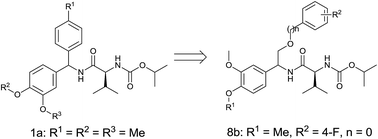
Valinamide carbamates are important agricultural fungicides with anti-oomycete activity and low toxicity toward mammalian cells. To find valinamide carbamates with high activity against resistant pathogens, a series of substituted 1-phenyl-2-phenoxyethylamino derivatives were designed and synthesized by introducing substituted phenyloxy or benzyloxy into valinamide carbamate leads. Bioassays showed that many title compounds exhibited good anti-oomycete activity. Compound 8b had much higher in vitro fungicidal activity against Phytophthora capsici than the control compound iprovalicarb and had a similar potency to the control mandipropamid. At 6.25 μg mL?1 the fungicidal activities of many compounds against in vivo Pseudoperonospora cubensis were greater than 30%, while the control dimethomorph gave only 27% activity at this concentration. The effect of 8b against Pseudoperonospora cubensis in the field indicates promise for a new candidate for controlling cucumber downy mildew.
Recommended Literature
- [1] Emerging investigator series: bacteriophages as nano engineering tools for quality monitoring and pathogen detection in water and wastewater Fereshteh BayatEnviron. Sci.: Nano, 2021,8, 367-389 10.1039/D0EN00962H
- [2] Evolved polymerases facilitate selection of fully 2′-OMe-modified aptamers? Zhixia Liu,Tingjian Chen,Floyd E. RomesbergChem. Sci., 2017,8, 8179-8182 10.1039/C7SC03747C
- [3] Establishment and implications of a characterization method for magnetic nanoparticle using cell tracking velocimetry and magnetic susceptibility modified solutions Huading Zhang,Lee R. Moore,Maciej Zborowski,P. Stephen Williams,Shlomo Margel,Jeffrey J. ChalmersAnalyst, 2005,130, 514-527 10.1039/B412723D
- [4] Dissociative electron attachment to HGaF4 Lewis–Br?nsted superacid Marcin Czapla,Jack SimonsPhys. Chem. Chem. Phys., 2018,20, 21739-21745 10.1039/C8CP04007A
- [5] Esterase-responsive polymeric prodrug-based tumor targeting nanoparticles for improved anti-tumor performance against colon cancer? Gang Pan,Yi-jie Bao,Jie Xu,Tao Liu,Cheng Liu,Yan-yan Qiu,Xiao-jing Shi,Hui Yu,Ting-ting Jia,Xia Yuan,Ze-ting Yuan,Yi-jun CaoRSC Adv., 2016,6, 42109-42119 10.1039/C6RA05236C
- [6] Evidence of field induced slow magnetic relaxation in cis-[Co(hfac)2(H2O)2] exhibiting tri-axial anisotropy with a negative axial component? Denis V. Korchagin,Elena A. Yureva,Alexander V. Akimov,Eugenii Ya. Misochko,Gennady V. Shilov,Artem D. Talantsev,Roman B. Morgunov,Alexander A. Shakin,Sergey M. Aldoshin,Boris S. TsukerblatDalton Trans., 2017,46, 7540-7548 10.1039/C7DT01236E
- [7] Exciplex emission from the mixed dimer of naphthalene and 2-cyanonaphthalene in a supersonic jet Aloke Das,K. K. Mahato,Chayan K. Nandi,Tapas Chakraborty,Shridhar R. Gadre,Nikhil A. GokhalePhys. Chem. Chem. Phys., 2002,4, 2162-2168 10.1039/B200124C
- [8] Evolution of dealloying induced strain in nanoporous gold crystals? Ross Harder,David C. Dunand,Ian McNultyNanoscale, 2017,9, 5686-5693 10.1039/C6NR09635B
- [9] Estimates of hydride ion stability in condensed systems: energy of formation and solvation in aqueous and polar-organic solvents Craig A. Kelly,David R. RosseinskyPhys. Chem. Chem. Phys., 2001,3, 2086-2090 10.1039/B010092G
- [10] Fe3O4 nanosphere@microporous organic networks: enhanced anode performances in lithium ion batteries through carbonization? Byungho Lim,Jaewon Jin,Jin Yoo,Seung Yong Han,Kyeongyeol Kim,Sungah Kang,Nojin Park,Sang Moon Lee,Hae Jin Kim,Seung Uk SonChem. Commun., 2014,50, 7723-7726 10.1039/C4CC02068E

Journal Name:RSC Advances
research_products
-

CAS no.: 89640-58-4


![N-(3-cyanothiolan-3-yl)-2-[(2,2,2-trifluoroethyl)sulfanyl]pyridine-4-carboxamide](https://ossimg.kuujia.com/scimg/1444500/1444113-98-7x500.png)

![1,2,3,4,5,6-Hexahydro-[2,3]bipyridinyl-6-ol](https://ossimg.kuujia.com/scimg/1271000/1270529-38-8x500.png)

![2,2-Difluoro-3-[methyl(2-methylbutyl)amino]propanoic acid](https://ossimg.kuujia.com/scimg/2138500/2138166-62-6x500.png)

![2-(1H-indol-3-yl)-N-{[6-(thiophen-2-yl)-[1,2,4]triazolo[4,3-b]pyridazin-3-yl]methyl}acetamide](https://ossimg.kuujia.com/scimg/2034500/2034271-14-0x500.png)