De novo biosynthesis of sex pheromone components of Helicoverpa armigera through an artificial pathway in yeast?
Green Chemistry Pub Date: 2021-12-21 DOI: 10.1039/D1GC02965G
Abstract
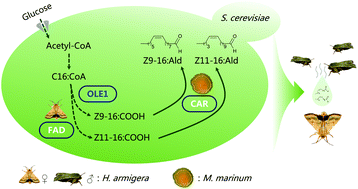
The cotton bollworm, Helicoverpa armigera, causes severe damage to the yields of cotton and other crops. (Z)-11-Hexadecenal (Z11–16?:?Ald) and (Z)-9-hexadecenal (Z9–16?:?Ald), as the main components of H. armigera sex pheromones, have been used as attractants, which is widely considered one of the environmentally friendly approaches for pest control. To achieve a more sustainable and economical synthesis of Z11–16?:?Ald and Z9–16?:?Ald, here we present artificial biosynthetic pathways for these two compounds to demonstrate the artificial de novo synthesis from glucose by engineered yeasts. First, a Saccharomyces cerevisiae strain with increased titers of free fatty acids was designed and constructed by knocking out several genes. Then de novo production of (Z)-11-hexadecenoic acid was achieved by functional screening and introduction of several lepidopteran Δ11 fatty-acyl desaturases (FADs) into the strain. A further engineered yeast strain equipped with FAD from H. armigera combined with downregulation of the native yeast OLE1 gene produced 47.4 mg L?1 (Z)-11-hexadecenoic acid and 87.6 mg L?1cis-9 isomer. A derivative strain capable of producing Z11–16?:?Ald and Z9–16?:?Ald was subsequently constructed by introduction of a heterologous carboxylic acid reductase (CAR). Through fed-batch fermentation, its production of Z11–16?:?Ald and Z9–16?:?Ald could reach 22.7 mg L?1 and 45.9 mg L?1, respectively. Finally, biological effectiveness assays demonstrated that the sex pheromone components purified from the fermentation liquid of the engineered yeast and even the raw extracts without purification exhibited similar biological activity to commercial standards. Our work achieved de novo biosynthesis of aldehyde components of H. armigera sex pheromone in a yeast cell factory, which makes it feasible to produce these sex pheromone components on a large scale with low costs, and thus facilitate the application of aldehyde pheromones for pest management.
Recommended Literature
- [1] An atomic scale study of defects in Co2FeAl Ravi Kumar Yadav,R. GovindarajPhys. Chem. Chem. Phys., 2020,22, 26876-26886 10.1039/D0CP04572A
- [2] An apparatus for testing water by measurement of its electrical conductivity Analyst, 1912,37, 538-543 10.1039/AN9123700538
- [3] An approach to biodegradable star polymeric architectures using disulfide coupling? Jingquan Liu,Huiyun Liu,Zhongfan Jia,Volga Bulmus,Thomas P. DavisChem. Commun., 2008, 6582-6584 10.1039/B817037A
- [4] An apparatus for determining small amounts of alchohol in sour milk and urine Analyst, 1964,89, 272-275 10.1039/AN9648900272
- [5] An approach to the structure and vibrational analysis of cis- and trans-3-chlorostyrene through IR/Raman and INS spectroscopies and theoretical ab initio/DFT calculations? J. M. Granadino-Roldán,M. Fernández-Gómez,A. Navarro,T. Pe?a Ruiz,U. A. JayasooriyaPhys. Chem. Chem. Phys., 2004,6, 1133-1143 10.1039/B314243D
- [6] An atomistic mechanism for the degradation of perovskite solar cells by trapped charge? Eunhak Lim,Jiyoung Heo,Seong Keun KimNanoscale, 2019,11, 11369-11378 10.1039/C9NR02193K
- [7] An approach for correlating the structural and electrical properties of Zr4+-modified SrBi4Ti4O15/SBT ceramic Priyambada Nayak,Tanmaya Badapanda,Anil Kumar Singh,Simanchalo PanigrahiRSC Adv., 2017,7, 16319-16331 10.1039/C7RA00366H
- [8] An assay for the enzyme N-acetyl-β-d-glucosaminidase (NAGase) based on electrochemical detection using screen-printed carbon electrodes (SPCEs) R. M. Pemberton,J. P. Hart,T. T. MottramAnalyst, 2001,126, 1866-1871 10.1039/B104874K
- [9] An artificial blood vessel implanted three-dimensional microsystem for modeling transvascular migration of tumor cells? Xue-Ying Wang,Ying Pei,Min Xie,Zi-He Jin,Ya-Shi Xiao,Yang Wang,Li-Na Zhang,Yan Li,Wei-Hua HuangLab Chip, 2015,15, 1178-1187 10.1039/C4LC00973H
- [10] An artificial CO-releasing metalloprotein built by histidine-selective metallation? Inês S. Albuquerque,Hélia F. Jeremias,Miguel Chaves-Ferreira,Dijana Matak-Vinkovic,Omar Boutureira,Carlos C. Rom?oChem. Commun., 2015,51, 3993-3996 10.1039/C4CC10204E

Journal Name:Green Chemistry
research_products
-

CAS no.: 89640-58-4

![1,2,3,4,5,6-Hexahydro-[2,3]bipyridinyl-6-ol](https://ossimg.kuujia.com/scimg/1271000/1270529-38-8x500.png)


![N-(3-cyanothiolan-3-yl)-2-[(2,2,2-trifluoroethyl)sulfanyl]pyridine-4-carboxamide](https://ossimg.kuujia.com/scimg/1444500/1444113-98-7x500.png)

![2,2-Difluoro-3-[methyl(2-methylbutyl)amino]propanoic acid](https://ossimg.kuujia.com/scimg/2138500/2138166-62-6x500.png)

![2-(1H-indol-3-yl)-N-{[6-(thiophen-2-yl)-[1,2,4]triazolo[4,3-b]pyridazin-3-yl]methyl}acetamide](https://ossimg.kuujia.com/scimg/2034500/2034271-14-0x500.png)