Covalent post-assembly modification in metallosupramolecular chemistry
Chemical Society Reviews Pub Date: 2017-11-16 DOI: 10.1039/C6CS00907G
Abstract
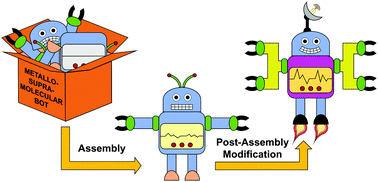
A growing variety of covalent reactions have been employed to achieve the post-assembly modification (PAM) of self-assembled metallosupramolecular complexes. Covalent PAM enables the late-stage derivatisation of pre-assembled parent complexes in a modular fashion, thus expanding the chemical space available for supramolecular synthesis. The oldest and most widespread implementation of covalent PAM is in metal-preorganised covalent synthesis. Recent work, however, has broadened the scope of covalent PAM to include: protocols for efficiently grafting new functionalities onto supramolecular architectures, reactions that permanently ‘lock-down’ metastable complexes, and covalent bond-forming stimuli that trigger controlled structural transformations between distinct supramolecular species. This review highlights key examples of each of these distinct kinds of covalent PAM in metallosupramolecular chemistry, before providing a perspective upon future challenges and opportunities.
Recommended Literature
- [1] Emerging investigator series: bacteriophages as nano engineering tools for quality monitoring and pathogen detection in water and wastewater Fereshteh BayatEnviron. Sci.: Nano, 2021,8, 367-389 10.1039/D0EN00962H
- [2] Empowering microfluidics by micro-3D printing and solution-based mineral coating? Hongxia Li,Aikifa Raza,Qiaoyu Ge,Jin-You Lu,TieJun ZhangSoft Matter, 2020,16, 6841-6849 10.1039/D0SM00958J
- [3] Evidence of rutile-to-anatase photo-induced electron transfer in mixed-phase TiO2 by solid-state NMR spectroscopy? Weili Dai,Guangjun Wu,Michael HungerChem. Commun., 2015,51, 13779-13782 10.1039/C5CC04971G
- [4] Fe(ii)-Assisted one-pot synthesis of ultra-small core–shell Au–Pt nanoparticles as superior catalysts towards the HER and ORR? Yi Cao,Yujiao Xiahou,Lixiang Xing,Xiang Zhang,Hong Li,ChenShou Wu,Haibing XiaNanoscale, 2020,12, 20456-20466 10.1039/D0NR04995F
- [5] Excellent energy storage performance in NaNbO3-based relaxor antiferroeic ceramics under a low electric field XuxinCheng,XiaomingChen,PengyuanFan 10.1007/s10832-022-00283-w
- [6] Fe3O4/Au/Fe3O4 nanoflowers exhibiting tunable saturation magnetization and enhanced bioconjugation Feng Shi,Kunping Yan,Mingli Peng,Xiao Cheng,Yanling Luo,Xuemei Chen,V. A. L. Roy,Zuankai WangNanoscale, 2012,4, 747-751 10.1039/C2NR11489E
- [7] Fe3O4 nanoclusters highly dispersed on a porous graphene support as an additive for improving the hydrogen storage properties of LiBH4? Guang Xu,Wei Zhang,Ying Zhang,Xiaoxia Zhao,Ping Wen,Di MaRSC Adv., 2018,8, 19353-19361 10.1039/C8RA02762E
- [8] Evolutionary approaches in protein engineering towards biomaterial construction Brindha J.,Balamurali M. M.,Kaushik ChandaRSC Adv., 2019,9, 34720-34734 10.1039/C9RA06807D
- [9] Enabling chloride salts for thermal energy storage: implications of salt purity? J. Matthew Kurley,Phillip W. Halstenberg,Abbey McAlister,Stephen Raiman,Richard T. MayesRSC Adv., 2019,9, 25602-25608 10.1039/C9RA03133B
- [10] Dissociative electron attachment to HGaF4 Lewis–Br?nsted superacid Marcin Czapla,Jack SimonsPhys. Chem. Chem. Phys., 2018,20, 21739-21745 10.1039/C8CP04007A

Journal Name:Chemical Society Reviews
research_products
-

CAS no.: 89640-58-4

![1,2,3,4,5,6-Hexahydro-[2,3]bipyridinyl-6-ol](https://ossimg.kuujia.com/scimg/1271000/1270529-38-8x500.png)


![N-(3-cyanothiolan-3-yl)-2-[(2,2,2-trifluoroethyl)sulfanyl]pyridine-4-carboxamide](https://ossimg.kuujia.com/scimg/1444500/1444113-98-7x500.png)

![2,2-Difluoro-3-[methyl(2-methylbutyl)amino]propanoic acid](https://ossimg.kuujia.com/scimg/2138500/2138166-62-6x500.png)

![2-(1H-indol-3-yl)-N-{[6-(thiophen-2-yl)-[1,2,4]triazolo[4,3-b]pyridazin-3-yl]methyl}acetamide](https://ossimg.kuujia.com/scimg/2034500/2034271-14-0x500.png)