Controlling the aqueous growth of urea crystals with different growth inhibitors: a molecular-scale study
RSC Advances Pub Date: 2021-04-06 DOI: 10.1039/D0RA10401A
Abstract
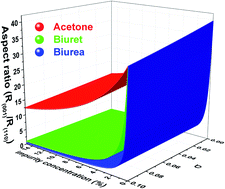
Molecular scale understanding of the mechanism of solution-mediated nucleation and the growth of crystalline materials in the presence of growth inhibitors together with the process parameters continues to attract the interest of the scientific community though much headway has been made in recent years. Growth inhibitors can be added to solution of a crystallizing parent molecule to alter the rate of growth of different crystal faces, size and shape of the crystalline materials. In this work, we investigated the effects of a number of shape-controlling inhibitors, such as acetone, biuret and biurea, on the growth kinetics of the various faces of aqueous-grown urea crystals as a means to predictably control the crystal growth morphology. We combined the adsorption energy landscape of various auxiliaries with the kinetics of the molecular growth processes to develop an analytical model to compute the rate of growth as a function of supersaturation and the additive concentration. The model relates the kinetic and thermodynamic aspects of the adsorption of the solute, solvent and additive to provide a quantitative description of the crystal growth. Ab initio periodic dispersion-corrected density functional theory using the hybrid exchange–correlation functional was employed to determine the interfacial structure of the adsorption of various auxiliaries at crystalline surfaces. The calculated adsorption energies of different auxiliaries were employed to examine the role played by these auxiliaries during the aqueous crystallization of urea crystals containing small amounts of additives. Our results showed that the growth of (110), (111) and (![[1 with combining macron]](https://www.rsc.org/images/entities/char_0031_0304.gif) ) faces were nearly unaltered by the addition of moderate amounts of acetone as it has lower adsorption energies with the surfaces of these faces. Nevertheless, the presence of acetone in the solution reasonably impeded the growth of the (001) face. The addition of biuret or biurea in the solution led to a higher adsorption energy at (001) and (111) faces. Consequently, the low concentration of these additives severely obstructed the growth of (001) and (111) faces as most of the adsorption sites were occupied by these additives. On the other hand, these additives were weakly adsorbed at the (110) face and, hence, the growth of the (110) face largely remained unaltered. Moreover, unlike biuret, biurea considerably inhibited the growth of the () face. Our results are in agreement with the experimental and computational results reported in the literature.
) faces were nearly unaltered by the addition of moderate amounts of acetone as it has lower adsorption energies with the surfaces of these faces. Nevertheless, the presence of acetone in the solution reasonably impeded the growth of the (001) face. The addition of biuret or biurea in the solution led to a higher adsorption energy at (001) and (111) faces. Consequently, the low concentration of these additives severely obstructed the growth of (001) and (111) faces as most of the adsorption sites were occupied by these additives. On the other hand, these additives were weakly adsorbed at the (110) face and, hence, the growth of the (110) face largely remained unaltered. Moreover, unlike biuret, biurea considerably inhibited the growth of the () face. Our results are in agreement with the experimental and computational results reported in the literature.
Recommended Literature
- [1] Excimer–monomer switch: a reaction-based approach for selective detection of fluoride? Qiao Song,Angela Bamesberger,Lingyun Yang,Haley Houtwed,Haishi CaoAnalyst, 2014,139, 3588-3592 10.1039/C4AN00522H
- [2] Evolution in surface coverage of CH3NH3PbI3?XClXvia heat assisted solvent vapour treatment and their effects on photovoltaic performance of devices Dhirendra K. Chaudhary,Pramendra Kumar,Lokendra KumarRSC Adv., 2016,6, 94731-94738 10.1039/C6RA18729C
- [3] Excimer and exciplex formation in a pair of bright phosphorescent isomers constructed from Cu3(pyrazolate)3 and Cu3I3 coordination luminophores? Shun-Ze Zhan,Mian Li,Xiao-Ping Zhou,Dan Li,Seik Weng NgRSC Adv., 2011,1, 1457-1459 10.1039/C1RA00566A
- [4] Excited state potential energy surfaces and their interactions in FeIVO active sites Shaun D. Wong,Edward I. SolomonDalton Trans., 2014,43, 17567-17577 10.1039/C4DT01366B
- [5] Empowering microfluidics by micro-3D printing and solution-based mineral coating? Hongxia Li,Aikifa Raza,Qiaoyu Ge,Jin-You Lu,TieJun ZhangSoft Matter, 2020,16, 6841-6849 10.1039/D0SM00958J
- [6] Dissolution of cork biopolymers in biocompatible ionic liquids Helga Garcia,Rui Ferreira,Marija Petkovic,Jamie L. Ferguson,Maria C. Leit?o,H. Q. Nimal Gunaratne,Luís Paulo N. RebeloGreen Chem., 2010,12, 367-369 10.1039/B922553F
- [7] Fast synthesis of red Li3BaSrLn3(WO4)8:Eu3+ phosphors for white LEDs under near-UV excitation by a microwave-assisted solid state reaction method and photoluminescence studies Bo Wei,Zhenyu Liu,Chen Xie,Shu Yang,Wentao Tang,Aiwei Gu,Wing-Tak Wong,Ka-Leung WongJ. Mater. Chem. C, 2015,3, 12322-12327 10.1039/C5TC03165F
- [8] Excellent mechanical performance and enhanced dielectric properties of OBC/SiO2 elastomeric nanocomposites: effect of dispersion of the SiO2 nanoparticles? Xing Zhao,Lu Bai,Rui-Ying Bao,Zheng-Ying Liu,Ming-Bo Yang,Wei YangRSC Adv., 2017,7, 46297-46305 10.1039/C7RA08074C
- [9] Fatty acid eutectic mixtures and derivatives from non-edible animal fat as phase change materials? Pau Gallart-Sirvent,Marc Martín,Gemma Villorbina,Mercè Balcells,Aran Solé,Luisa F. Cabeza,Ramon Canela-GarayoaRSC Adv., 2017,7, 24133-24139 10.1039/C7RA03845C
- [10] EWOD-driven droplet microfluidic device integrated with optoelectronic tweezers as an automated platform for cellular isolation and analysis? Gaurav J. Shah,Eric P.-Y. Chiou,Ming C. Wu,Chang-Jin “CJ” KimLab Chip, 2009,9, 1732-1739 10.1039/B821508A

Journal Name:RSC Advances
research_products
-

CAS no.: 89640-58-4


![N-(3-cyanothiolan-3-yl)-2-[(2,2,2-trifluoroethyl)sulfanyl]pyridine-4-carboxamide](https://ossimg.kuujia.com/scimg/1444500/1444113-98-7x500.png)

![1,2,3,4,5,6-Hexahydro-[2,3]bipyridinyl-6-ol](https://ossimg.kuujia.com/scimg/1271000/1270529-38-8x500.png)

![2,2-Difluoro-3-[methyl(2-methylbutyl)amino]propanoic acid](https://ossimg.kuujia.com/scimg/2138500/2138166-62-6x500.png)

![2-(1H-indol-3-yl)-N-{[6-(thiophen-2-yl)-[1,2,4]triazolo[4,3-b]pyridazin-3-yl]methyl}acetamide](https://ossimg.kuujia.com/scimg/2034500/2034271-14-0x500.png)