Controlling the stereoselectivity of rac-LA polymerization by chiral recognition induced the formation of homochiral dimeric metal alkoxides?
Polymer Chemistry Pub Date: 2016-01-13 DOI: 10.1039/C5PY02005K
Abstract
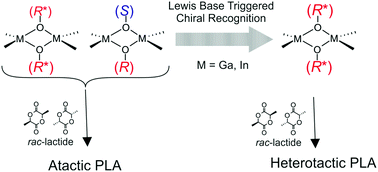
Using dimeric dialkylgallium and dialkylindium alkoxide catalysts for the polymerization of rac-lactide (rac-LA), we have shown for the first time that the formation of homochiral dimeric species [Me2MOR]2 (M = Ga, In), induced by chiral recognition of monomeric Me2MOR units in the presence of Lewis base, leads to an increase of the heteroselectivity of the ring opening polymerization (ROP) of rac-LA, and therefore provides a new tool for controlling the stereoselectivity of the polymerization of heterocyclic monomers. To explain the origin of the heteroselectivity of the [Me2Ga(μ-OCH(Me)CO2Me)]2/Lewis base system in the ROP of rac-LA, structure of (S,S)-[Me2Ga(μ-OCH(Me)CO2Me)]2 ((S,S)-1) and rac-[Me2Ga(μ-OCH(Me)CO2Me)]2 (1) in the absence and presence of tertiary amines and pyridines was investigated. Studies were further extended by analysis of the structure/activity data for both (S,S)-[Me2In(μ-OCH(Me)CO2Me)]2 ((S,S)-2) and rac-[Me2In(μ-OCH(Me)CO2Me)]2 (2). Contrary to gallium complex 1, which exists in a solution as equimolar mixture of homo- and heterochiral diastereomers, an excess of homochiral (R*,R*)-2 species was observed in the case of 2. For both the Ga and In complexes, the interaction of amines with the metal center increased the tendency for the formation of homochiral species with retention of the dimeric structure in the solution. This tendency was additionally demonstrated by the structure of model dialkylgallium (3) and indium (4) complexes with monoanionic ligands possessing chiral centers in the α-position to the alkoxide oxygen and pyridine functionalities. The polymerization of rac-LA with gallium and indium catalysts (S,S)-1 and (S,S)-2 resulted in the formation of heterotactically enriched polylactide (PLA) (Pr = 0.50–0.85) and (Pr = 0.54–0.72), respectively. The heteroselectivity of the investigated systems was in line with the excess of the homochiral catalytic species. The higher activity of homochiral species activated by amines resulted in a positive non-linear effect between an excess of homochiral (R*,R*)-1 or (R*,R*)-2 catalysts and the heterotacticity of the obtained PLA. The observed dependence of stereoselectivity of rac-LA polymerization on the excess of homochiral species was similar to the asymmetric amplification in enantioselective organic catalysis; however, it is exceptional in polymerization processes.
Recommended Literature
- [1] Estimating and correcting interference fringes in infrared spectra in infrared hyperspectral imaging Ghazal Azarfar,Ebrahim Aboualizadeh,Nicholas M. Walter,Simona Ratti,Camilla Olivieri,Alessandra Norici,Michael Nasse,Achim Kohler,Mario GiordanoAnalyst, 2018,143, 4674-4683 10.1039/C8AN00093J
- [2] Dissociative electron attachment to HGaF4 Lewis–Br?nsted superacid Marcin Czapla,Jack SimonsPhys. Chem. Chem. Phys., 2018,20, 21739-21745 10.1039/C8CP04007A
- [3] Enabling shape memory and healable effects in a conjugated polymer by incorporating siloxane via dynamic imine bond? Yaling Zhang,Chunhui Dai,Shiwei Zhou,Bin LiuChem. Commun., 2018,54, 10092-10095 10.1039/C8CC05410J
- [4] Evolution of important glucosinolates in three common Brassica vegetables during their processing into vegetable powder and in vitro gastric digestion Nan Fu,Naphaporn Chiewchan,Xiao Dong ChenFood Funct., 2020,11, 211-220 10.1039/C9FO00811J
- [5] Examination of deposit in commercial diluted phosphoric acid Analyst, 1880,5, 146-147 10.1039/AN8800500146
- [6] Evidence of CO2 molecule acting as an electron acceptor on a nanoporous metal–organic-framework MIL-53 or Cr3+(OH)(O2C–C6H4–CO2)? Alexandre Vimont,Arnaud Travert,Philippe Bazin,Jean-Claude Lavalley,Marco Daturi,Christian Serre,Gérard Férey,Sandrine Bourrelly,Philip L. LlewellynChem. Commun., 2007, 3291-3293 10.1039/B703468G
- [7] Evolution in surface coverage of CH3NH3PbI3?XClXvia heat assisted solvent vapour treatment and their effects on photovoltaic performance of devices Dhirendra K. Chaudhary,Pramendra Kumar,Lokendra KumarRSC Adv., 2016,6, 94731-94738 10.1039/C6RA18729C
- [8] Examination of ammonia–poly(pyrrole) interactions by piezoelectric and conductivity measurements Analyst, 1991,116, 1125-1130 10.1039/AN9911601125
- [9] Fate of Sb(v) and Sb(iii) species along a gradient of pH and oxygen concentration in the Carnoulès mine waters (Southern France) Eléonore Resongles,Corinne Casiot,Fran?oise Elbaz-Poulichet,Rémi Freydier,Odile Bruneel,Christine Piot,Sophie Delpoux,Aurélie Volant,Angélique DesoeuvreEnviron. Sci.: Processes Impacts, 2013,15, 1536-1544 10.1039/C3EM00215B
- [10] Evolutionary approaches in protein engineering towards biomaterial construction Brindha J.,Balamurali M. M.,Kaushik ChandaRSC Adv., 2019,9, 34720-34734 10.1039/C9RA06807D

Journal Name:Polymer Chemistry
research_products
-

CAS no.: 89640-58-4


![N-(3-cyanothiolan-3-yl)-2-[(2,2,2-trifluoroethyl)sulfanyl]pyridine-4-carboxamide](https://ossimg.kuujia.com/scimg/1444500/1444113-98-7x500.png)

![1,2,3,4,5,6-Hexahydro-[2,3]bipyridinyl-6-ol](https://ossimg.kuujia.com/scimg/1271000/1270529-38-8x500.png)

![2,2-Difluoro-3-[methyl(2-methylbutyl)amino]propanoic acid](https://ossimg.kuujia.com/scimg/2138500/2138166-62-6x500.png)

![2-(1H-indol-3-yl)-N-{[6-(thiophen-2-yl)-[1,2,4]triazolo[4,3-b]pyridazin-3-yl]methyl}acetamide](https://ossimg.kuujia.com/scimg/2034500/2034271-14-0x500.png)