Chemical route derived bismuth ferrite thin films and nanomaterials
Journal of Materials Chemistry C Pub Date: 2016-03-29 DOI: 10.1039/C6TC00243A
Abstract
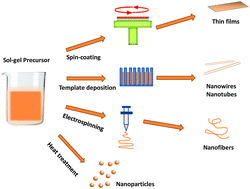
Bismuth ferrite (BiFeO3 – BFO) is a prototypical lead-free single phase multiferroic which shows strong ferroelectric and antiferromagnetic properties simultaneously, together with high ferroelectric Curie temperature (TFE ~ 1103 K) and Néel temperature (TN ~ 643 K). BFO thin films and nanomaterials (collectively termed here ‘nanostructured BFO’) show many fascinating functional properties are not observed in the parent bulk compound. In this review we focus on chemical route-derived nanostructured BFO: thin films, nanowires and nanoparticles. The review covers governing factors in a detailed and systematic manner so as to give readers a clear picture of the current state of the art in the development of nanostructured BFO via chemical routes. We discuss the process pathways for each of the chemical (or soft) based synthesis techniques, highlighting both the advantages and challenges faced for each method. Specific emphasis is placed on understanding the role of each processing ingredient and development of optimized precursors. Finally we identify the opportunities posed by further development of chemical routes for this fascinating materials system. The review thus sheds significant insight into successfully achieving high-quality nanostructured BFO via chemical process techniques.
Recommended Literature
- [1] Evolved polymerases facilitate selection of fully 2′-OMe-modified aptamers? Zhixia Liu,Tingjian Chen,Floyd E. RomesbergChem. Sci., 2017,8, 8179-8182 10.1039/C7SC03747C
- [2] Excellent mechanical performance and enhanced dielectric properties of OBC/SiO2 elastomeric nanocomposites: effect of dispersion of the SiO2 nanoparticles? Xing Zhao,Lu Bai,Rui-Ying Bao,Zheng-Ying Liu,Ming-Bo Yang,Wei YangRSC Adv., 2017,7, 46297-46305 10.1039/C7RA08074C
- [3] Emerging investigator series: heterogeneous reactions of sulfur dioxide on mineral dust nanoparticles: from single component to mixed components? Tao Wang,Yangyang Liu,Yue Deng,Hongbo Fu,Jianmin ChenEnviron. Sci.: Nano, 2018,5, 1821-1833 10.1039/C8EN00376A
- [4] Enabling chloride salts for thermal energy storage: implications of salt purity? J. Matthew Kurley,Phillip W. Halstenberg,Abbey McAlister,Stephen Raiman,Richard T. MayesRSC Adv., 2019,9, 25602-25608 10.1039/C9RA03133B
- [5] Emergence of microfluidic wearable technologies Joo Chuan Yeo,KenryLab Chip, 2016,16, 4082-4090 10.1039/C6LC00926C
- [6] Emerging enantiomeric resolution materials with homochiral nano-fabrications Ji-Ping WeiNanoscale, 2015,7, 11815-11832 10.1039/C5NR03048J
- [7] Evidence of pre-micellar aggregates in aqueous solution of amphiphilic PDMS–PEO block copolymer? Domenico Lombardo,Gianmarco Munaò,Pietro Calandra,Luigi Pasqua,Maria Teresa CaccamoPhys. Chem. Chem. Phys., 2019,21, 11983-11991 10.1039/C9CP02195G
- [8] Evolving better nanoparticles: Genetic algorithms for optimising cluster geometries Dalton Trans., 2003, 4193-4207 10.1039/B305686D
- [9] Exciplex emission from the mixed dimer of naphthalene and 2-cyanonaphthalene in a supersonic jet Aloke Das,K. K. Mahato,Chayan K. Nandi,Tapas Chakraborty,Shridhar R. Gadre,Nikhil A. GokhalePhys. Chem. Chem. Phys., 2002,4, 2162-2168 10.1039/B200124C
- [10] Ester-directed orthogonal dual C–H activation and ortho aryl C–H alkenylation via distal weak coordination? Manickam Bakthadoss,Tadiparthi Thirupathi Reddy,Vishal Agarwal,Duddu S. SharadaChem. Commun., 2022,58, 1406-1409 10.1039/D1CC06097J

Journal Name:Journal of Materials Chemistry C
research_products
-

CAS no.: 89640-58-4


![N-(3-cyanothiolan-3-yl)-2-[(2,2,2-trifluoroethyl)sulfanyl]pyridine-4-carboxamide](https://ossimg.kuujia.com/scimg/1444500/1444113-98-7x500.png)

![1,2,3,4,5,6-Hexahydro-[2,3]bipyridinyl-6-ol](https://ossimg.kuujia.com/scimg/1271000/1270529-38-8x500.png)

![2,2-Difluoro-3-[methyl(2-methylbutyl)amino]propanoic acid](https://ossimg.kuujia.com/scimg/2138500/2138166-62-6x500.png)

![2-(1H-indol-3-yl)-N-{[6-(thiophen-2-yl)-[1,2,4]triazolo[4,3-b]pyridazin-3-yl]methyl}acetamide](https://ossimg.kuujia.com/scimg/2034500/2034271-14-0x500.png)