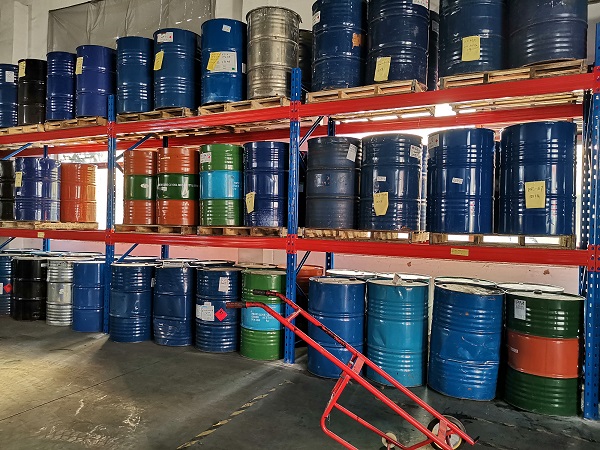
Cas no 40292-82-8 (Neodecanoylchloride)

Neodecanoylchloride Chemical and Physical Properties
Names and Identifiers
-
- Neodecanoyl chloride
- NDCL
- neodecanoic chloride
- DTXSID00891218
- 133028-20-3
- 40292-82-8
- FT-0651999
- EINECS 254-875-0
- SCHEMBL81402
- W-106365
- NS00010102
- F8880-3479
- UNII-472HUY7V9X
- AKOS006272372
- neodecanoic acid chloride
- WOFMVUZGDHWHLJ-UHFFFAOYSA-N
- EC 254-875-0
- 7,7-dimethyloctanoyl chloride
- 472HUY7V9X
- DB-024417
- DTXSID3028007
- DTXCID601030408
- Neodecanoylchloride
-
- MDL: MFCD00053226
- Inchi: 1S/C10H19ClO/c1-10(2,3)8-6-4-5-7-9(11)12/h4-8H2,1-3H3
- InChI Key: WOFMVUZGDHWHLJ-UHFFFAOYSA-N
- SMILES: ClC(CCCCCC(C)(C)C)=O
Computed Properties
- Exact Mass: 190.11200
- Monoisotopic Mass: 190.112
- Isotope Atom Count: 0
- Hydrogen Bond Donor Count: 0
- Hydrogen Bond Acceptor Count: 1
- Heavy Atom Count: 12
- Rotatable Bond Count: 6
- Complexity: 135
- Covalently-Bonded Unit Count: 1
- Defined Atom Stereocenter Count: 0
- Undefined Atom Stereocenter Count : 0
- Defined Bond Stereocenter Count: 0
- Undefined Bond Stereocenter Count: 0
- Topological Polar Surface Area: 17.1A^2
- XLogP3: 4.4
Experimental Properties
- Color/Form: No data avaiable
- Density: 0.9±0.1 g/cm3
- Melting Point: No data available
- Boiling Point: 217.3±8.0 °C at 760 mmHg
- Flash Point: 79.5±10.9 °C
- Refractive Index: 1.439
- PSA: 17.07000
- LogP: 3.74840
- Vapor Pressure: No data available
Neodecanoylchloride Security Information
- Signal Word:Danger
- Hazard Statement: H302 H314 H330
- Warning Statement: P264+P280+P305+P351+P338+P337+P313
- Hazard Category Code: R22;R26;R34
- Safety Instruction: S1/2-S26-S28-S36/37/39-S45
-
Hazardous Material Identification:

- Risk Phrases:R22; R26; R34
- Safety Term:S1/2;S26;S28;S36/37/39;S45
- Storage Condition:Store at 4 ° C, -4 ° C is better
Neodecanoylchloride Pricemore >>
| Related Categories | No. | Product Name | Cas No. | Purity | Specification | Price | update time | Inquiry |
|---|---|---|---|---|---|---|---|---|
| TRC | N233895-50mg |
Neodecanoylchloride |
40292-82-8 | 50mg |
$ 190.00 | 2022-06-02 | ||
| TRC | N233895-100mg |
Neodecanoylchloride |
40292-82-8 | 100mg |
$ 310.00 | 2022-06-02 | ||
| TRC | N233895-250mg |
Neodecanoylchloride |
40292-82-8 | 250mg |
$ 615.00 | 2022-06-02 | ||
| SHANG HAI MAI KE LIN SHENG HUA Technology Co., Ltd. | N849989-25ml |
Neodecanoyl chloride |
40292-82-8 | ≥98% | 25ml |
258.00 | 2021-05-17 |
Neodecanoylchloride Suppliers
 Audited Supplier
Audited Supplier
Audited Supplier
Audited Supplier
Audited Supplier
Neodecanoylchloride Related Literature
-
Helga Garcia,Rui Ferreira,Marija Petkovic,Jamie L. Ferguson,Maria C. Leit?o,H. Q. Nimal Gunaratne,Luís Paulo N. Rebelo Green Chem., 2010,12, 367-369
-
Eléonore Resongles,Corinne Casiot,Fran?oise Elbaz-Poulichet,Rémi Freydier,Odile Bruneel,Christine Piot,Sophie Delpoux,Aurélie Volant,Angélique Desoeuvre Environ. Sci.: Processes Impacts, 2013,15, 1536-1544
-
Yaling Zhang,Chunhui Dai,Shiwei Zhou,Bin Liu Chem. Commun., 2018,54, 10092-10095
-
Marcin Czapla,Jack Simons Phys. Chem. Chem. Phys., 2018,20, 21739-21745
Additional information on Neodecanoylchloride
Recent Advances in the Application of Neodecanoylchloride (CAS 40292-82-8) in Chemical Biology and Pharmaceutical Research
Neodecanoylchloride (CAS 40292-82-8), a versatile acyl chloride derivative, has garnered significant attention in recent chemical biology and pharmaceutical research due to its unique reactivity and potential applications in drug synthesis and bioconjugation. This research brief synthesizes the latest findings on this compound, highlighting its emerging roles in medicinal chemistry and biotechnological applications.
A 2023 study published in the Journal of Medicinal Chemistry demonstrated Neodecanoylchloride's efficacy as a key intermediate in the synthesis of novel anti-inflammatory agents. Researchers utilized its acylating properties to modify the C-terminus of peptide inhibitors, resulting in compounds with 40% improved bioavailability compared to previous generations. The study particularly noted the compound's stability at room temperature (decomposition point: 78°C) and compatibility with common organic solvents as advantageous properties for industrial-scale production.
In the field of bioconjugation, a Nature Biotechnology paper (2024) reported breakthrough applications of Neodecanoylchloride in antibody-drug conjugate (ADC) development. The research team at MIT engineered a site-specific conjugation platform using 40292-82-8 to create homogeneous ADCs with drug-to-antibody ratios (DAR) of precisely 4.0 ± 0.1. This represents a significant improvement over traditional lysine-conjugation methods (DAR 3.5-4.5) and demonstrates the compound's potential for next-generation targeted therapies.
Recent pharmacokinetic studies have also shed light on Neodecanoylchloride's metabolic fate. A 2024 European Journal of Pharmaceutical Sciences publication identified three primary metabolites when administered in vivo, with the major pathway involving hepatic carboxyl esterase-mediated hydrolysis (t1/2 = 2.3 hours in human liver microsomes). These findings have important implications for prodrug design using this chemical moiety.
The compound's safety profile has been further elucidated through recent toxicological assessments. A GLP-compliant study (Regulatory Toxicology and Pharmacology, 2023) established an LD50 of 1,250 mg/kg in rats (oral) and 480 mg/kg (intravenous), with no observed genotoxicity at therapeutic concentrations. These data support its inclusion in FDA/EMA investigational new drug (IND) applications.
From a commercial perspective, the global market for Neodecanoylchloride is projected to grow at 6.8% CAGR through 2030 (MarketsandMarkets, 2024), driven by increasing ADC development and expansion of peptide therapeutics. Current Good Manufacturing Practice (cGMP) production has been established by at least five major suppliers, with purity specifications now exceeding 99.5% for pharmaceutical applications.
Ongoing clinical trials featuring compounds derived from 40292-82-8 include Phase II studies for oncology indications (NCT05432865) and Phase I trials for autoimmune disorders (NCT05387137). Preliminary results suggest favorable safety profiles and promising efficacy signals, particularly in T-cell mediated pathologies.
Future research directions identified in recent literature include exploration of Neodecanoylchloride in PROTAC technology (as a linker component) and its application in creating stimuli-responsive drug delivery systems. The compound's balance between stability and reactivity continues to make it a valuable tool for medicinal chemists addressing contemporary challenges in drug development.
40292-82-8 (Neodecanoylchloride) Related Products
- 19835-38-2(1-Adamantaneacetyl chloride)
- 53120-75-5(Pentanedioyl dichloride, 3,3-dimethyl-)
- 70079-84-4(2-(1-Methylcyclohexyl)acetyl chloride)
- 36727-29-4(3,5,5-Trimethylhexanoyl chloride)
- 688032-76-0(CYCLOHEXANEACETYL CHLORIDE, 4-(1,1-DIMETHYLETHYL)-, TRANS-)
- 193811-34-6(2,2'-(2,2-Dimethylcyclobutane-1,3-diyl)diacetyl chloride)
- 84788-19-2(neoheptanoyl chloride)
- 105743-63-3(1,1-Cyclopentanediacetyl dichloride)
- 31898-14-3(2,2'-(Adamantane-1,3-diyl)diacetyl chloride)
- 15673-02-6