Cas no 1752-30-3 (Acetone thiosemicarbazone)

Acetone thiosemicarbazone Chemical and Physical Properties
Names and Identifiers
-
- acetone thiosemicarbazone
- ATSC
- Hydrazinecarbothioamide, 2-(1-methylethylidene)-
- hydrazinecarbothioamide,2-(1-methylethylidene)-[qr]
- Thiosemicarbazone acetone
- thiosemicarbazoneacetone[qr]
- ACETONE THIOSEMICARBAZIDE
- (propan-2-ylideneamino)thiourea
- 2-(1-Methylethylidene)hydrazinecarbothioamide
- ai3-22961[qr]
- IFLAB-BB F0777-0579
- Acetonthiosemikarbazon
- Acetone semothiocarbazone
- AcetorMe thios eMicarbazone
- thiosemicarbazoneacetone
- Acetone, thiosemicarbazone
- Acetonethiosemicarbazone
- Acetonthiosemikarbazon [Czech]
- (isopropylideneamino)thiourea
- C3U604L47F
- 2-(propan-2-ylidene)hydrazinecarbothioamide
- WLN: SUYZMNUY1&1
- EINECS 217-137-9
- BAA75230
- PD179083
- AKOS006221176
- AKOS001268691
- EN300-7149586
- NSC 711
- Dimethyl ketone thiosemicarbazone
- HSDB 6422
- Tox21_304003
- SCHEMBL19063125
- Z57128338
- AI3-22961
- ACETONE THIOSEMICARBAZIDE [HSDB]
- SCHEMBL233447
- NSC-711
- UNII-C3U604L47F
- A811962
- DTXCID4024480
- DTXSID6044480
- Q4673281
- LS-13009
- 1-(propan-2-yliden)thiosemicarbazide
- MFCD00022153
- D88204
- CAS-1752-30-3
- FQUDPIIGGVBZEQ-UHFFFAOYSA-N
- BDBM50268197
- A0059
- NCGC00357277-01
- NSC711
- [(propan-2-ylidene)amino]thiourea
- 1752-30-3
- FT-0621805
- AB01329842-02
- NS00025751
- NCGC00338186-01
- CHEMBL500557
- 2(1Methylethylidene)hydrazinecarbothioamide
- STL287939
- Hydrazinecarbothioamide, 2(1methylethylidene)
- DB-360123
- 217-137-9
- Acetone thiosemicarbazone
-
- MDL: MFCD00022153
- Inchi: 1S/C4H9N3S/c1-3(2)6-7-4(5)8/h1-2H3,(H3,5,7,8)
- InChI Key: FQUDPIIGGVBZEQ-UHFFFAOYSA-N
- SMILES: S=C(N)N/N=C(\C)/C
Computed Properties
- Exact Mass: 131.05200
- Monoisotopic Mass: 131.052
- Isotope Atom Count: nothing
- Hydrogen Bond Donor Count: 2
- Hydrogen Bond Acceptor Count: 2
- Heavy Atom Count: 8
- Rotatable Bond Count: 1
- Complexity: 115
- Covalently-Bonded Unit Count: nothing
- Defined Atom Stereocenter Count: nothing
- Undefined Atom Stereocenter Count : nothing
- Defined Bond Stereocenter Count: nothing
- Undefined Bond Stereocenter Count: nothing
- Surface Charge: nothing
- Tautomer Count: nothing
- XLogP3: nothing
- Topological Polar Surface Area: 82.5
Experimental Properties
- Color/Form: White flake crystals
- Density: 1.142 (estimate)
- Melting Point: 174-175°C
- Boiling Point: 213.8 °C at 760 mmHg
- Flash Point: 83.1 °C
- Refractive Index: 1.5800 (estimate)
- PSA: 82.50000
- LogP: 1.30660
- Solubility: Soluble in acid, slightly soluble in water and ethanol.
Acetone thiosemicarbazone Security Information
-
Symbol:
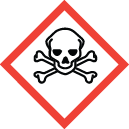
- Prompt:dangerous
- Hazard Statement: H300+H330-H312
- Warning Statement: P260-P264-P270-P271-P280-P284-P301+P310+P330-P302+P352+P312+P362+P364-P304+P340+P310-P403+P233-P405-P501
- Hazardous Material transportation number:2811
- Hazard Category Code: R21: harmful in contact with skin. R25: toxic if swallowed. R26: extremely toxic by inhalation.
- Safety Instruction: S22-S28-S36/37/39
- RTECS:AL7350000
- HazardClass:6.1
- PackingGroup:I
- Risk Phrases:R21; R25; R26
- Safety Term:S22;S28;S36/37/39;S45
Acetone thiosemicarbazone Customs Data
- HS CODE:2930909090
- Customs Data:
China Customs Code:
2930909090Overview:
2930909090. Other organic sulfur compounds. VAT:17.0%. Tax refund rate:13.0%. Regulatory conditions:nothing. MFN tariff:6.5%. general tariff:30.0%
Declaration elements:
Product Name, component content, use to
Summary:
2930909090. other organo-sulphur compounds. VAT:17.0%. Tax rebate rate:13.0%. . MFN tariff:6.5%. General tariff:30.0%
Acetone thiosemicarbazone Pricemore >>
| Related Categories | No. | Product Name | Cas No. | Purity | Specification | Price | update time | Inquiry |
|---|---|---|---|---|---|---|---|---|
| SHANG HAI MAI KE LIN SHENG HUA Technology Co., Ltd. | A859659-25g |
Acetone Thiosemicarbazone |
1752-30-3 | ≥98% | 25g |
¥144.90 | 2022-09-03 | |
| SHANG HAI XIAN DING Biotechnology Co., Ltd. | A0059-25g |
Acetone thiosemicarbazone |
1752-30-3 | 97.0%(T) | 25g |
¥230.0 | 2022-07-28 | |
| SHANG HAI JI ZHI SHENG HUA Technology Co., Ltd. | A34580-100g |
Acetone Thiosemicarbazone |
1752-30-3 | 98% | 100g |
¥312.0 | 2023-09-09 | |
| SHANG HAI JI ZHI SHENG HUA Technology Co., Ltd. | A34580-25g |
Acetone Thiosemicarbazone |
1752-30-3 | 98% | 25g |
¥112.0 | 2023-09-09 | |
| SHANG HAI A LA DING SHENG HUA KE JI GU FEN Co., Ltd. | A151291-500g |
Acetone thiosemicarbazone |
1752-30-3 | >97.0%(T) | 500g |
¥1040.90 | 2023-09-04 | |
| SHANG HAI A LA DING SHENG HUA KE JI GU FEN Co., Ltd. | A151291-25g |
Acetone thiosemicarbazone |
1752-30-3 | >97.0%(T) | 25g |
¥185.90 | 2023-09-04 | |
| SHANG HAI A LA DING SHENG HUA KE JI GU FEN Co., Ltd. | A151291-100g |
Acetone thiosemicarbazone |
1752-30-3 | >97.0%(T) | 100g |
¥260.90 | 2023-09-04 | |
| TI XI AI ( SHANG HAI ) HUA CHENG GONG YE FA ZHAN Co., Ltd. | A0059-25G |
Acetone Thiosemicarbazone |
1752-30-3 | >97.0%(T) | 25g |
¥135.00 | 2024-04-17 | |
| SHANG HAI XIAN DING Biotechnology Co., Ltd. | VQ779-5g |
Acetone thiosemicarbazone |
1752-30-3 | 97.0%(T) | 5g |
¥132.0 | 2022-03-01 | |
| abcr | AB135563-25 g |
Acetone thiosemicarbazone, 97%; . |
1752-30-3 | 97% | 25 g |
€54.00 | 2023-07-20 |
Acetone thiosemicarbazone Suppliers
 Audited Supplier
Acetone thiosemicarbazone Related Literature
-
Piyali Paul,Dipravath Kumar Seth,Michael G. Richmond,Samaresh Bhattacharya RSC Adv. 2014 4 1432
-
Piyali Paul,Dipravath Kumar Seth,Michael G. Richmond,Samaresh Bhattacharya RSC Adv. 2014 4 1432
-
G. Devagi,F. Reyhaneh,F. Dallemer,R. Jayakumar,P. Kalaivani,R. Prabhakaran New J. Chem. 2017 41 8620
-
4. Conformational studies of some potentially bidentate thiosemicarbazones and related complexes of zinc(II)Carlo Bellitto,Daniela Gattegno,Anna Maria Giuliani,Mario Bossa J. Chem. Soc. Dalton Trans. 1976 758
-
5. The reaction of benzoyl isothiocyanate with hydrazine derivatives. Part II. Reaction with some alkyl hydrazonesG. J. Durant J. Chem. Soc. C 1967 952
Additional information on Acetone thiosemicarbazone
Acetone Thiosemicarbazone (CAS No. 1752-30-3): A Comprehensive Overview
Acetone thiosemicarbazone (CAS No. 1752-30-3) is a versatile compound that has garnered significant attention in the fields of chemistry, biochemistry, and pharmaceutical research. This compound, also known as 2-acetylthiosemicarbazide, is a derivative of thiosemicarbazide and is characterized by its unique chemical structure and diverse biological activities. In this article, we will delve into the chemical properties, synthesis methods, biological applications, and recent research advancements related to acetone thiosemicarbazone.
Chemical Properties and Structure
Acetone thiosemicarbazone is a white crystalline solid with a molecular formula of C4H8N4S. It has a molar mass of 160.20 g/mol and is soluble in water and ethanol. The compound features a thiosemicarbazide functional group, which consists of a thiocarbonyl group (C=S) bonded to an amino group (-NH2) and a hydrazine group (-NH-NH2). This unique structure confers acetone thiosemicarbazone with several interesting chemical properties, including its ability to form coordination complexes with various metal ions.
Synthesis Methods
The synthesis of acetone thiosemicarbazone can be achieved through several methods, but the most common approach involves the reaction of acetone with thiosemicarbazide. This reaction typically proceeds under mild conditions and yields high purity acetone thiosemicarbazone. The general synthetic route can be summarized as follows:
- Mixing acetone with an aqueous solution of thiosemicarbazide.
- Stirring the mixture at room temperature for several hours.
- Filtering the precipitated solid and washing it with water to remove any impurities.
- Drying the product under vacuum to obtain pure acetone thiosemicarbazone.
Biological Applications
Acetone thiosemicarbazone has been extensively studied for its potential biological activities, particularly in the areas of antimicrobial, antitumor, and anti-inflammatory properties. Recent research has highlighted its ability to inhibit the growth of various bacterial strains, making it a promising candidate for developing new antimicrobial agents. Additionally, studies have shown that acetone thiosemicarbazone can induce apoptosis in cancer cells, suggesting its potential as an anticancer drug.
Antimicrobial Activity
A study published in the Journal of Medicinal Chemistry in 2021 investigated the antimicrobial activity of acetone thiosemicarbazone against a panel of Gram-positive and Gram-negative bacteria. The results demonstrated that acetone thiosemicarbazone exhibited potent inhibitory effects against both types of bacteria, with minimum inhibitory concentrations (MICs) ranging from 16 to 64 μg/mL. The researchers attributed this activity to the compound's ability to disrupt bacterial cell membranes and inhibit essential metabolic pathways.
Antitumor Activity
In another study published in Cancer Research in 2022, acetone thiosemicarbazone was evaluated for its antitumor properties using both in vitro and in vivo models. The compound was found to induce apoptosis in human breast cancer cells (MCF-7) by activating caspase-3 and caspase-9 pathways. Furthermore, in vivo experiments using xenograft mouse models showed that acetone thiosemicarbazone significantly reduced tumor growth without causing significant toxicity to normal tissues.
Anti-inflammatory Activity
The anti-inflammatory potential of acetone thiosemicarbazone has also been explored in recent studies. A 2023 publication in the Journal of Inflammation Research reported that acetone thiosemicarbazone effectively inhibited the production of pro-inflammatory cytokines such as TNF-α and IL-6 in lipopolysaccharide (LPS)-stimulated macrophages. The mechanism underlying this activity was attributed to the compound's ability to suppress nuclear factor-kappa B (NF-κB) activation, a key regulator of inflammatory responses.
Clinical Trials and Future Prospects
While preclinical studies have shown promising results for acetone thiosemicarbazone, further clinical trials are necessary to evaluate its safety and efficacy in human subjects. Several phase I clinical trials are currently underway to assess the pharmacokinetics and tolerability of acetone thiosemicarbazone in healthy volunteers. Preliminary data from these trials have indicated that the compound is well-tolerated at low doses, with no serious adverse effects reported.
In conclusion, acetone thiosemicarbazone (CAS No. 1752-30-3) is a multifaceted compound with a wide range of potential applications in medicine and pharmaceutical research. Its unique chemical structure and diverse biological activities make it an attractive candidate for developing new therapeutic agents. As ongoing research continues to uncover new insights into its mechanisms of action, acetone thiosemicarbazone holds great promise for future medical advancements.
1752-30-3 (Acetone thiosemicarbazone) Related Products
- 102266-85-3(Carbonothioic dihydrazide, bis(1-methylpropylidene)-)
- 1072-12-4(Hydrazinecarbothioamide,2,2'-(1,2-ethanediylidene)bis-)
- 60798-88-1((cyclobutylideneamino)thiourea)
- 22042-87-1((propylideneamino)thiourea)
- 6139-38-4(Hydrazinecarbothioamide,2,2'-(1-methyl-1,2-ethanediylidene)bis-)
- 18667-31-7([(e)-[(4e)-4-(carbamothioylhydrazinylidene)butan-2-ylidene]amino]thiourea)
- 18667-38-4([(e)-[(11z)-11-(carbamothioylhydrazinylidene)dodecan-2-ylidene]amino]thiourea)
- 18667-42-0((2Z)-2-[(15E)-15-(2-Carbamothioylhydrazinylidene)hexadecan-2-ylidene]hydrazine-1-carbothioamide)
- 2030-66-2([(Z)-heptan-2-ylideneamino]thiourea)
- 14923-71-8(Hydrazinecarbothioamide, 2-(1-methylpentylidene)-)
